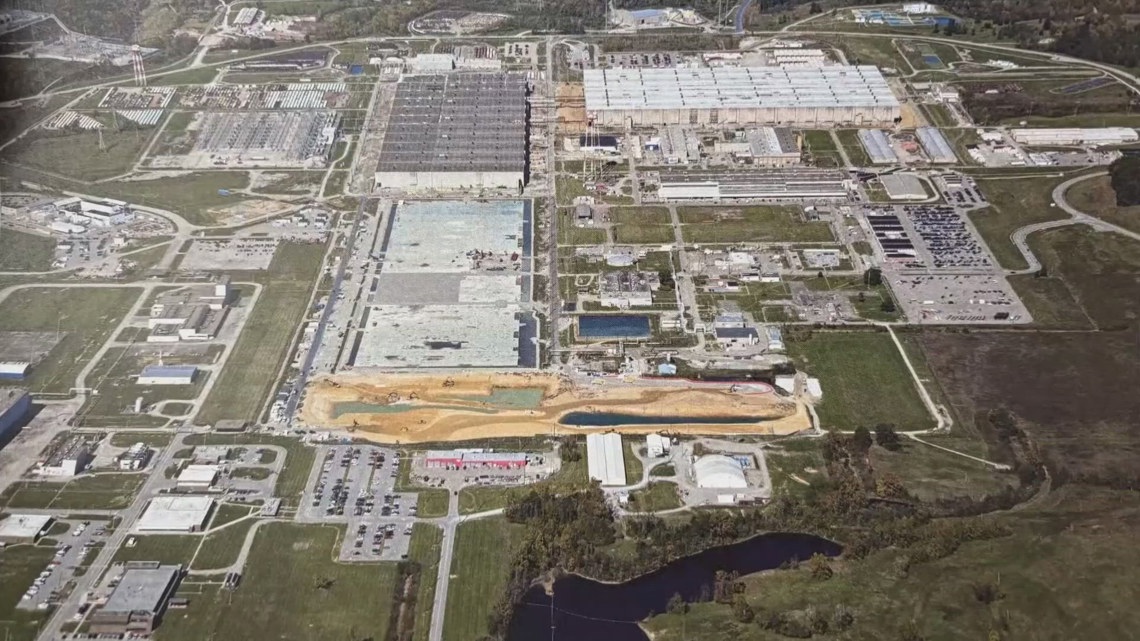
SoftBank will build a 10 GW power plant (including 9.2 GW of natural gas) and a 10 GW AI data center in Pike County as a $33 billion project expected to be operational in two years. The company is committing $4 billion to local AEP Ohio grid upgrades, projects ~35,000 peak construction jobs and ~2,500 permanent jobs, and positions this as the first phase of a $550 billion U.S.-Japan trade and investment plan with an eventual $1 trillion U.S. data-center investment ambition. Federal officials backed SoftBank's claim that on-site generation and a Ratepayer Protection Pledge will prevent increases to residential electricity bills; impacts are likely sectoral (energy/data-center infrastructure) rather than market-wide.
A very large, vertically integrated AI campus materially changes local and regional energy economics: a merchant generator paired with an on-site load creates a concentrated new demand center that will suppress marginal wholesale prices at off-peak hours while increasing transmission congestion and locational basis spreads during peaks. That divergence creates arbitrage opportunities for pipeline owners and for grid services (frequency response, black-start) providers but also raises the probability that incremental grid costs get socialized through utility rate cases rather than paid directly by the developer.
Supply-chain consequences are uneven: hyperscaler incumbents that sell colo/interconnect services will see some demand displacement where bespoke campuses absorb hyperscale workloads, while commodity suppliers of AI compute (GPUs, racks, cooling, power conversion) and heavy electrical kit stand to see a multi-year orderbook extension. Construction and specialized labor markets will tighten regionally, producing wage inflation that lifts margins for firms that can pass through execution premiums or capture scarcity pricing.
Regulatory and execution risk are the dominant near- to medium-term catalysts: environmental reviews, pipeline and transmission permitting, capacity market impacts, and how regulators allocate stranded-cost recovery can all delay or reprice the project on 6–36 month horizons. Financial risk stems from capital allocation and follow-through — if the developer scales back, equipment and contractor exposure becomes a source of downcycle pain.
For investors the key is positioning around durable supply-demand shifts (chips, power equipment, pipeline capacity) while hedging regulatory and execution binary risk; prefer vendors with long lead times and backlogs over pure-play colo REITs that face incremental competition from owner-operators.
AI-powered research, real-time alerts, and portfolio analytics for institutional investors.
Request DemoOverall Sentiment
strongly positive
Sentiment Score
0.70
