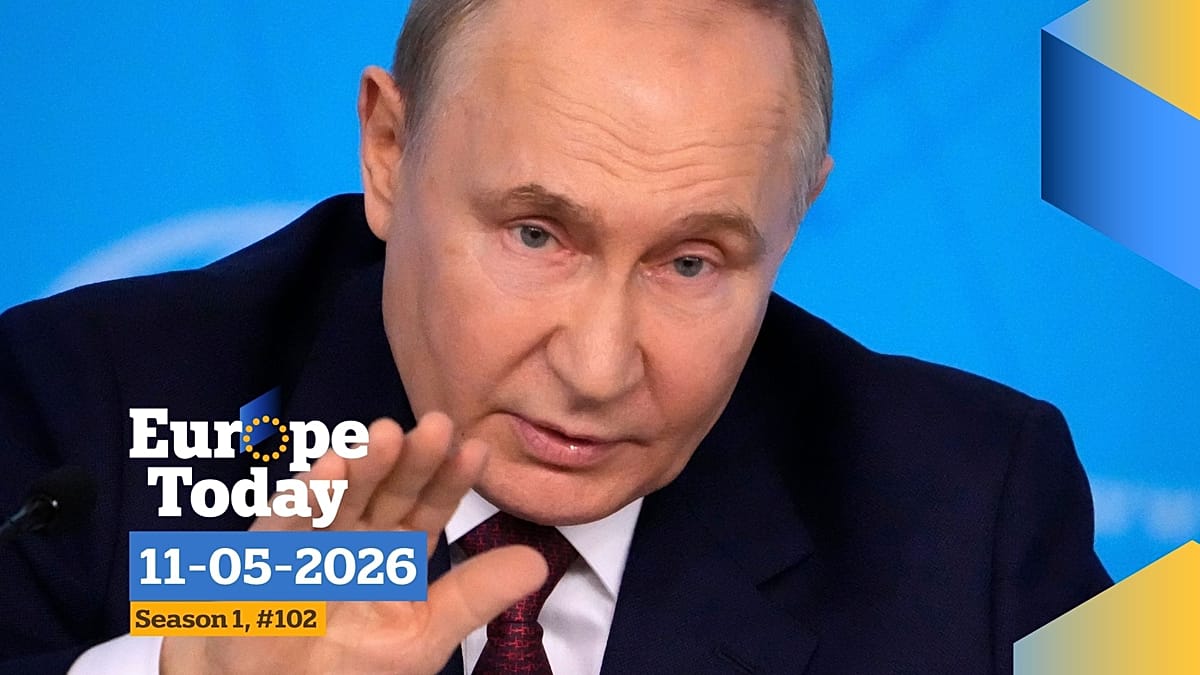
The article previews Euronews' Europe Today program, highlighting coverage of Moscow's military parade, Putin's remarks on the Ukraine war potentially nearing its last stage, and discussions about mediation proposals involving former German Chancellor Gerhard Schröder. It also notes interviews and political coverage tied to UK local elections and Hungary's latest political developments. The content is informational and programming-focused rather than market-moving.
The market takeaway is not the headline rhetoric but the signal that Moscow is trying to shape expectations around a longer bargaining window while keeping military pressure intact. That tends to benefit European defense equities on any dip, because even a perceived opening for talks usually leads to higher near-term procurement urgency rather than lower budgets; Berlin, Stockholm, and Warsaw are the clearest follow-through jurisdictions.
A second-order effect is on European risk assets more broadly: any credible mediation narrative can briefly compress energy and defense risk premia, but unless there is verifiable de-escalation, the fade is usually fast. The better read is that this is a volatility event for European cyclicals and the euro, not a durable regime change; the time horizon for a real reversal is months, not days, and requires observable ceasefire mechanics or sanctions relief signals.
The domestic politics angle matters because weak coalition stability in the UK and Hungary increases policy noise exactly when markets want continuity on fiscal, security, and EU coordination issues. That raises the odds of fragmented policy responses, which is mildly negative for regional banks, defense-integrators with government exposure, and broad European small caps that depend on stable public-spending visibility.
Contrarian view: consensus may overstate the incremental macro impact of peace headlines and underweight the fact that negotiations often front-load uncertainty. If talks stall, the unwind can be sharp; if they advance, it is more likely to reprice along a long timeline via lower implied volatility and softer energy costs than through an immediate rotation out of defense.
AI-powered research, real-time alerts, and portfolio analytics for institutional investors.
Request DemoOverall Sentiment
neutral
Sentiment Score
-0.10
