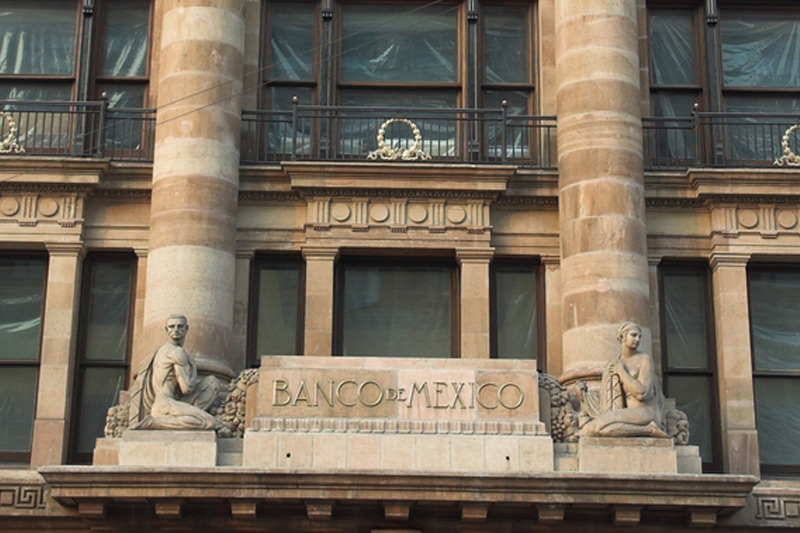
Banxico published new regulations on June 29, 2026 allowing it to buy select local government securities as a liquidity backstop, a notable policy shift following Moody's sovereign downgrade and S&P outlook cut on Mexico. The central bank kept its benchmark rate unchanged at 6.5% on June 25, while USD/MXN traded at 17.4671, down 0.19%, and iShares MSCI Mexico ETF (EWW) rose 1.38% to $76.41 on above-average volume. The move is aimed at stabilizing money-market conditions rather than broad stimulus, but it signals rising concern about sovereign-credit pressure and potential market-access stress.
The key market signal is not that Banxico can support liquidity; it is that policymakers are now willing to pre-commit a backstop before stress appears. That lowers the probability of a disorderly local-duration shock in the next few weeks, which is supportive for Mexican sovereign ETFs and bank balance sheets, but it also makes the curve more vulnerable to a different regime: slower policy normalization if foreign ownership of local bonds starts to retrench. The first-order relief trade is likely already mostly priced; the second-order opportunity is in relative value between instruments that benefit from liquidity provision and those exposed to further downgrade contagion.
The most interesting vulnerability is the sovereign-banking feedback loop. If rating pressure forces domestic institutions to absorb more government paper, balance-sheet capacity gets crowded out, credit creation slows, and the liquidity facility becomes a patch rather than a cure. That would be constructive for short-dated bill holders but negative for banks with higher HQLA dependence and for any asset manager whose AUM is linked to EM debt inflows. The timeline matters: over days, this is a confidence event; over months, it becomes a funding-cost and capital-allocation problem if the ratings agencies keep leaning negative.
MCO is the cleanest public-market loser from this setup because a weaker sovereign-credit narrative tends to delay issuance windows and compress advisory/ratings activity while increasing the risk of a larger, more contentious downgrade cycle later. The bigger contrarian point is that the peso reaction may be too calm: as long as the facility is untested, FX is pricing the announcement as optionality, not as insurance against a real stop-loss event. If the next rating action hits or Pemex support widens, the market can reprice rapidly from a benign liquidity story to a capital-flight story, and that move would likely be larger in local bonds than in FX.
AI-powered research, real-time alerts, and portfolio analytics for institutional investors.
Request DemoOverall Sentiment
neutral
Sentiment Score
0.15
Ticker Sentiment
