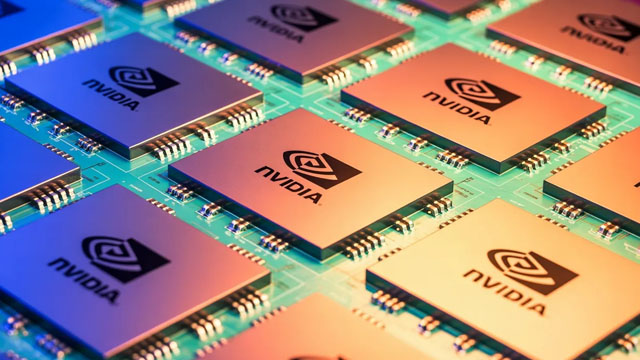
Nvidia launched a revenue-sharing programme for fast-growing AI startups, providing token credits to access computing power in exchange for a share of future revenue. The initiative is intended to accelerate startup development while expanding Nvidia’s AI platform usage. Overall, the move is directionally supportive for Nvidia’s ecosystem, but the article provides no financial magnitude indicating immediate large market impact.
This is less a near-term revenue lever than an ecosystem defense move. NVDA is effectively using cheap compute credits as customer acquisition spend to embed its stack into the earliest stages of AI startup formation, which can raise switching costs before model architectures, tooling, and optimization paths harden around competitors. The second-order benefit is that even if the program is economically immaterial today, it can preserve GPU utilization and keep future frontier demand captive as startups scale.
The real competitive angle is not the startups themselves but the adjacent platforms: hyperscalers, cloud aggregators, and alternative accelerators. If NVDA becomes the default financing layer for AI-native companies, it weakens AMD’s attempt to win share on price/performance alone and makes it harder for clouds to disintermediate NVDA with bundled credits. Over 6-18 months, the program could also improve NVDA’s venture access and data visibility into which applications are gaining traction, effectively turning compute distribution into a pipeline for option value on future winners.
The risk is that the market overreads the strategic significance. Token credits sound expansive, but unless the program is large and repeatable, the financial impact is likely negligible versus NVDA’s core data-center engine. A false signal would be any evidence that these credits mainly subsidize non-scalable startups or that the future revenue share is too small, too delayed, or too hard to collect. The key falsifier is if management later frames this as marketing spend with no measurable attach rate, or if margin comments show the program dilutes economics rather than deepens lock-in.
AI-powered research, real-time alerts, and portfolio analytics for institutional investors.
Request DemoOverall Sentiment
mildly positive
Sentiment Score
0.25
Ticker Sentiment
