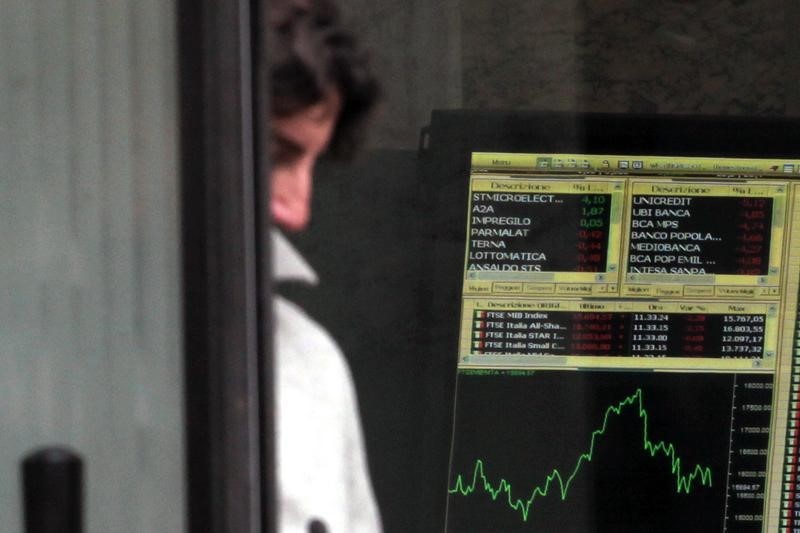
Italy's FTSE MIB fell 0.89% at the close, with weakness led by Technology, Industrials and Chemicals, while Ferrari (+3.14%), DiaSorin (+2.92%) and Italgas (+1.36%) outperformed. Saipem (-5.18%), Amplifon (-4.84%) and STMicroelectronics (-3.77%) were the worst laggards, and breadth was negative at 440 decliners versus 287 advancers. Commodities were sharply lower in oil, with WTI down 3.98% to $69.06 and Brent down 3.99% to $72.49, while gold rose 1.43% to $4,105.32 and the euro was little changed against the dollar and sterling.
The tape is signaling a classic factor rotation rather than a clean macro regime shift: lower oil is a near-term tax cut for consumers and cyclicals, but the market is still rewarding balance-sheet quality and defensives over high-beta industrial/tech exposure. That helps explain why the strongest names are those with self-help or idiosyncratic catalysts, while the weakest are businesses with immediate sensitivity to capex, spreads, or end-demand re-rating. The key second-order effect is that a sustained decline in crude should compress inflation expectations further, which can steepen the path toward easier policy and support rate-sensitive growth, but only if the move in energy is not interpreted as a demand warning.
Within semis, the weakness in STM looks more like a positioning and demand-duration problem than an earnings reset. European semiconductor names tend to get hit harder when macro is mixed because they lack the same AI-led narrative support as U.S. peers, so any further drawdown could spill into suppliers tied to autos, industrial automation, and analog inventory digestion. If crude stays weak and the dollar stays soft, European exporters get some FX relief, but that benefit likely accrues with a lag and won’t offset near-term margin pressure from softer industrial order momentum.
The contrarian read is that the move in energy may be overdone on a one-day basis: a nearly 4% slide in crude usually flushes momentum buyers before physical balances actually change. If the macro data were interpreted as merely disinflationary rather than recessionary, the setup is constructive for healthcare and selected large-cap quality names, while the weakest balance-sheet cyclicals remain vulnerable to another round of de-risking. Over the next 2-6 weeks, the market will likely reward companies with pricing power and clean earnings revisions, and punish anything exposed to inventory destocking or capex delay.
AI-powered research, real-time alerts, and portfolio analytics for institutional investors.
Request DemoOverall Sentiment
neutral
Sentiment Score
-0.05
Ticker Sentiment
