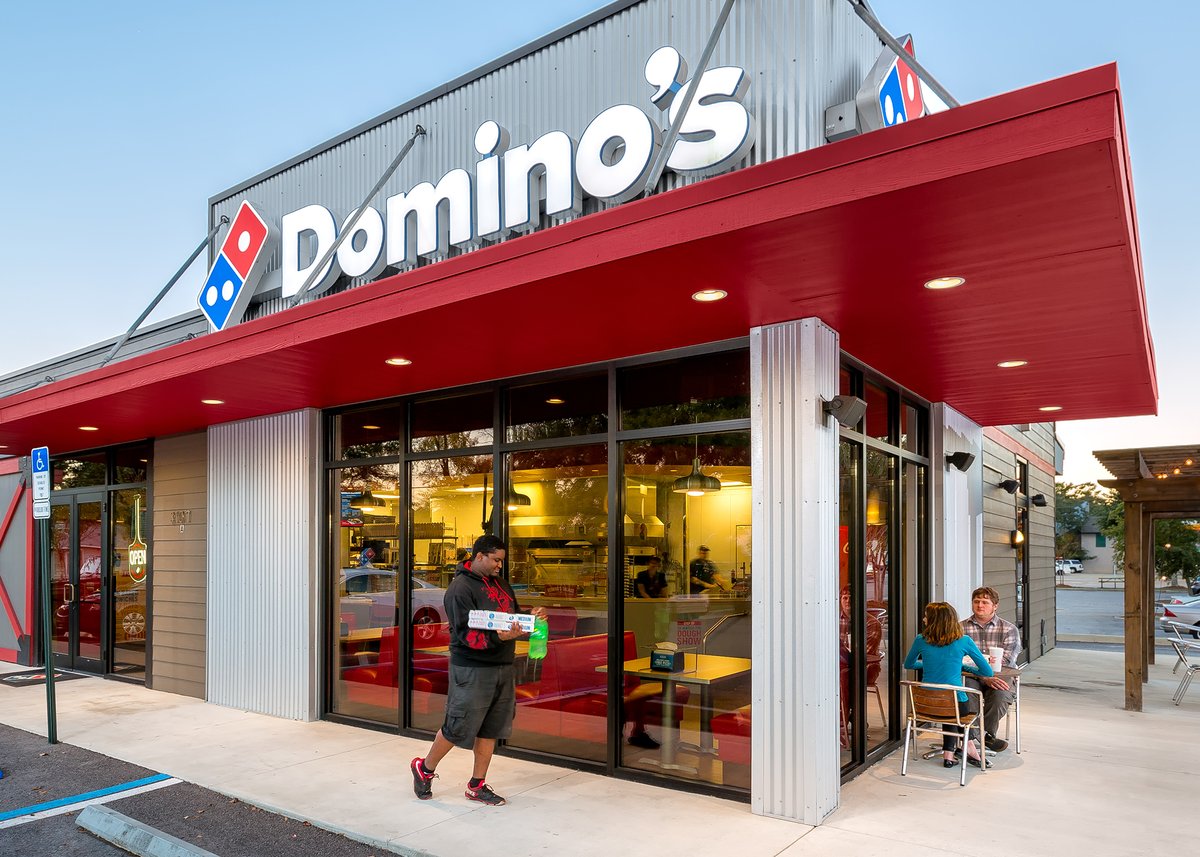
Domino's reported fiscal Q3 results with global retail sales up 6.3% YoY, company sales up 6.2%, U.S. comparable sales roughly +5.3% (international comps +1.7%) and operating income up 12.2%; the chain opened 214 net new stores in the quarter and operates ~21,700 stores with 99% franchised. Growth was driven by higher delivery pricing and franchising fees, supporting a 1.6% dividend yield and reinforcing Domino's positioning as a resilient, Buffett-attractive, market-leading franchise model amid a high-inflation environment.
Market structure: Domino’s (DPZ) benefits directly — franchisor cash flows (royalties/fees) rise with comps (+5.3% US, +6.3% global) while franchisees and supply partners (cheese, wheat) capture the margin variation. Aggregators (Uber Eats/DoorDash) are secondary losers in pizza where Domino’s proprietary ordering/delivery tech preserves pricing and reduces commission leakage. Incremental unit growth (214 stores/qtr) lifts top-line but raises local density risk; expect modest intra-brand cannibalization where openings concentrate.
Risk assessment: Primary tail risks are a sharp commodity shock (cheese/wheat +20% Y/Y), adverse labor/franchise liability regulation, or a systemic delivery-IT outage—each could compress operating income >200–300 bps within quarters. Immediate moves hinge on quarterly comps and EPS prints (days); short-term (weeks–months) depends on international comps and FX translation; long-term (3–5 years) rests on franchisee economics and sustained unit growth. Hidden dependency: DPZ revenues scale but remain tied to franchisee profitability — prolonged wage inflation can slow AUVs and new-store cadence.
Trade implications: Direct play: modest long in DPZ as a defensive growth name — enter 1–2% portfolio weight, scale to 3% if next two U.S. comps >+6% or stock dips >8%. Pair trade: Long DPZ vs short PZZA (Papa John’s) to capture superior unit economics and tech moat over 6–12 months. Options: sell 90–120 day 5% OTM cash-secured puts to collect premium or sell covered calls if holding, targeting annualized yield >6%.
Contrarian angles: Consensus prices stability; it underestimates franchisee margin stress from rising labor/insurance costs which could slow unit growth — this is under-acknowledged downside. Conversely, market may underprice international same-store profit leverage as new stores scale (5.7% intl sales lift) and fixed-cost absorption improves over 2–4 quarters. Watch for cannibalization and franchisee defaults as unintended consequences of aggressive global expansion.
AI-powered research, real-time alerts, and portfolio analytics for institutional investors.
Request DemoOverall Sentiment
mildly positive
Sentiment Score
0.35
Ticker Sentiment
