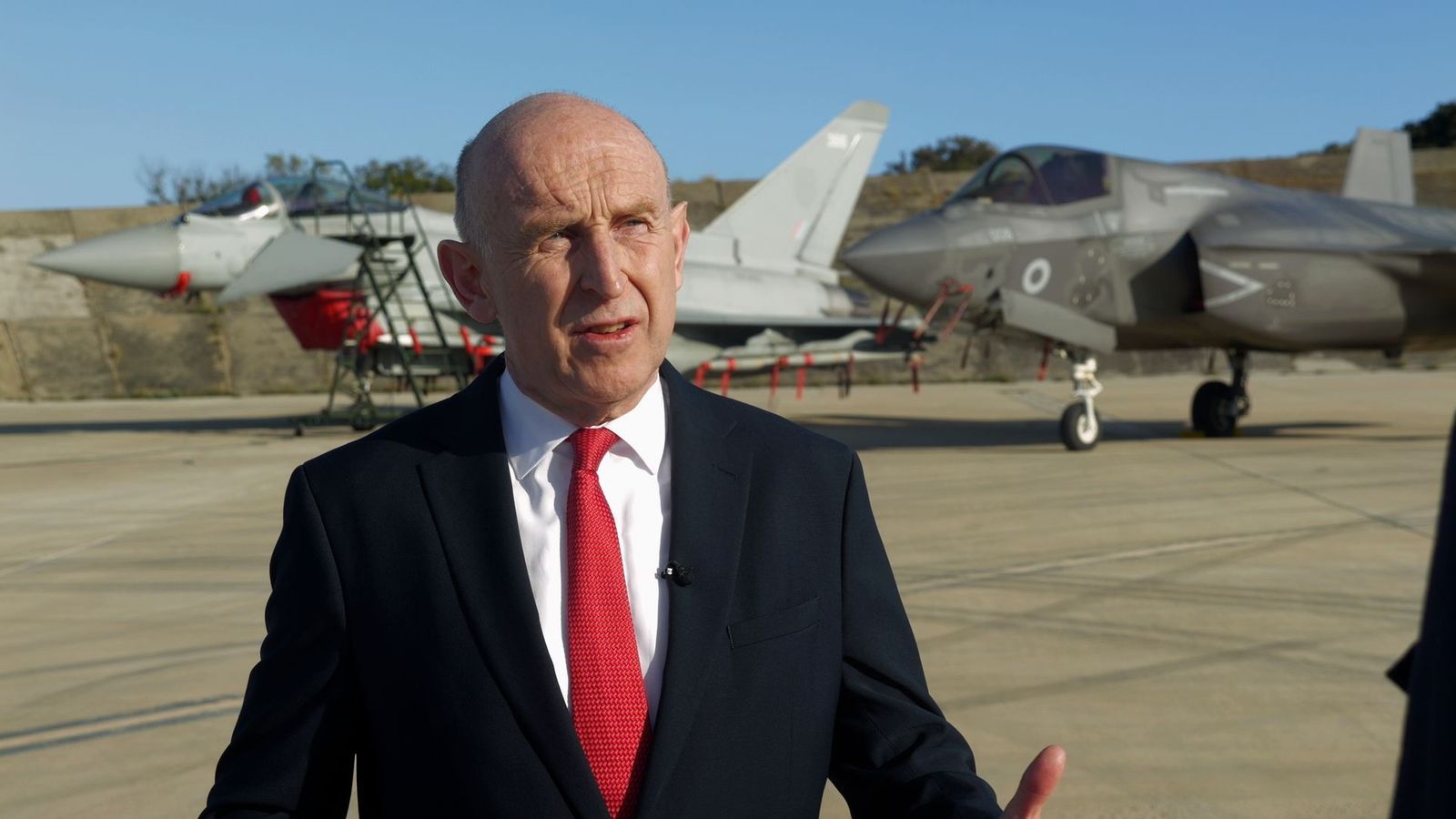
UK defence secretary John Healey twice declined to rule out Britain participating in offensive strikes on Iran while visiting RAF Akrotiri, which was recently targeted by drones; he emphasized adaptability and said current UK actions remain defensive and coordinated with allies. The government has moved to reinforce regional air defences, dispatched planners to coordinate an international response and decided to deploy the air-defence warship HMS Dragon to the eastern Mediterranean (departure delayed), signalling elevated regional risk and potential for wider escalation that warrants monitoring for geopolitical and market implications.
Market Structure: A UK minister refusing to rule out offensive action against Iran increases tail-risk pricing for defence, energy, and insurance lines. Expect near-term bid for large-cap defence primes (LMT, RTX, NOC, BA.L) and integrated oil majors (XOM, CVX, BP.L) while carriers (IAG.L, LHA.DE) and regional travel names underperform; commodities (Brent, WTI) should see a 5–15% risk premium uplift within days if strikes escalate.
Risk Assessment: Tail scenarios include a wider Gulf blockade or strikes on shipping lanes (low prob ~5–15% over 3 months but high impact), driving Brent > +20% and spiking inflation; conversely diplomatic de-escalation could mean rapid mean-reversion. Time dynamics: immediate days—volatility spikes and flight-to-safety; weeks—re-rating for defence and energy; quarters—capital budgets and TMT cyclicals repriced if sustained conflict.
Trade Implications: Favor convex, short-duration protection and selective directional exposure: buy defence/energy equity exposure funded by short cyclical travel/insurance; use options to limit drawdown and capture volatility. Cross-asset: expect USD and JPY strength, gilts/UST rally as safe-haven then potential yield repricing if oil-driven inflation persists—position duration accordingly.
Contrarian Angles: Consensus may overpay for defence on headline risk; history (2019 Iran skirmishes) shows 2–6 week dislocations and partial retracements. If Brent rallies >10% quickly, consider shorting defence swing after first 20–30% run (mean reversion risk) and look to buy beaten-up airlines on a 6–12 week horizon if containment occurs.
AI-powered research, real-time alerts, and portfolio analytics for institutional investors.
Request TrialOverall Sentiment
moderately negative
Sentiment Score
-0.45
