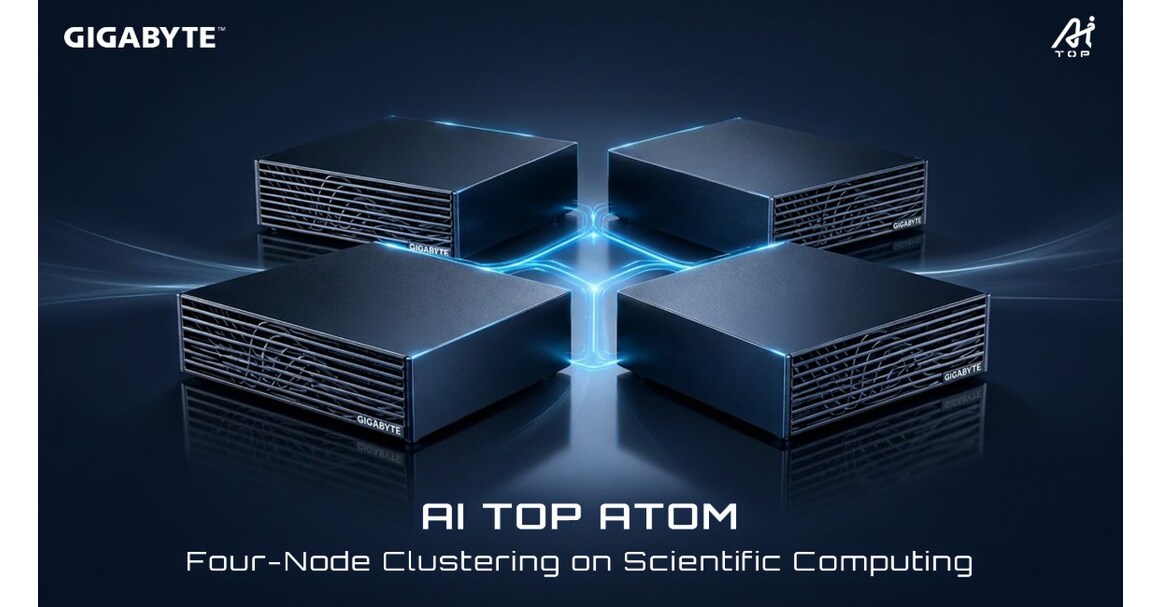
GIGABYTE presentó el clúster de cuatro nodos AI TOP ATOM para computación científica local, con cada nodo ofreciendo 1 PFLOPS en FP4 y 128 GB de memoria unificada, conectados vía switch 200GbE (RoCE). El enfoque modular permite escalar de 1 a 4 nodos para ejecutar cargas intensivas en memoria y aumentar simulaciones (p.ej., de ~10M átomos en sistemas independientes a >30M átomos). La demostración, en colaboración con NVIDIA (blueprints NemoClaw), orquesta Nemotron-3-Nano-30B-NVFP4 y ejecuta GROMACS para I+D en materiales de interfaz térmica (TIM) para encapsulado avanzado de semiconductores.
This reads more like ecosystem validation than a direct earnings catalyst. The market implication is that Nvidia’s moat is increasingly anchored in full-stack cluster economics — accelerator, memory, and interconnect — rather than just single-GPU performance, which matters because memory-bound scientific workloads are exactly where customers tolerate premium pricing if it shortens turnaround time. The upside is incremental share capture in enterprise and sovereign AI budgets; the downside is that these deployments still tend to be pilot-heavy and can take quarters to convert into recurring revenue.
Second-order winners are the networking and rack-scale infrastructure layers: if local, secure AI clusters gain traction, the spending shifts toward high-bandwidth switching, thermal management, and integration services. That favors vendors that can sell the whole node-to-cluster stack, while pressuring point solutions and cloud-only narratives if enterprises decide some inference/training should stay on-prem. The real question is not whether the demo works, but whether procurement teams see a better TCO than renting capacity from hyperscalers.
Contrarian view: the market may be overrating how broad this adoption path is. Scientific computing and advanced packaging are attractive proof points, but they represent a niche slice of total AI capex; if broader enterprise orders do not inflect, this remains a branding win more than a numbers win. Time horizon matters: any stock reaction should be measured in days, but the financial read-through is 1-3 quarters away; it would be falsified by flat data-center commentary, weak networking attach, or evidence that customers choose cheaper multi-vendor clusters.
AI-powered research, real-time alerts, and portfolio analytics for institutional investors.
Request DemoOverall Sentiment
mildly positive
Sentiment Score
0.20
Ticker Sentiment
