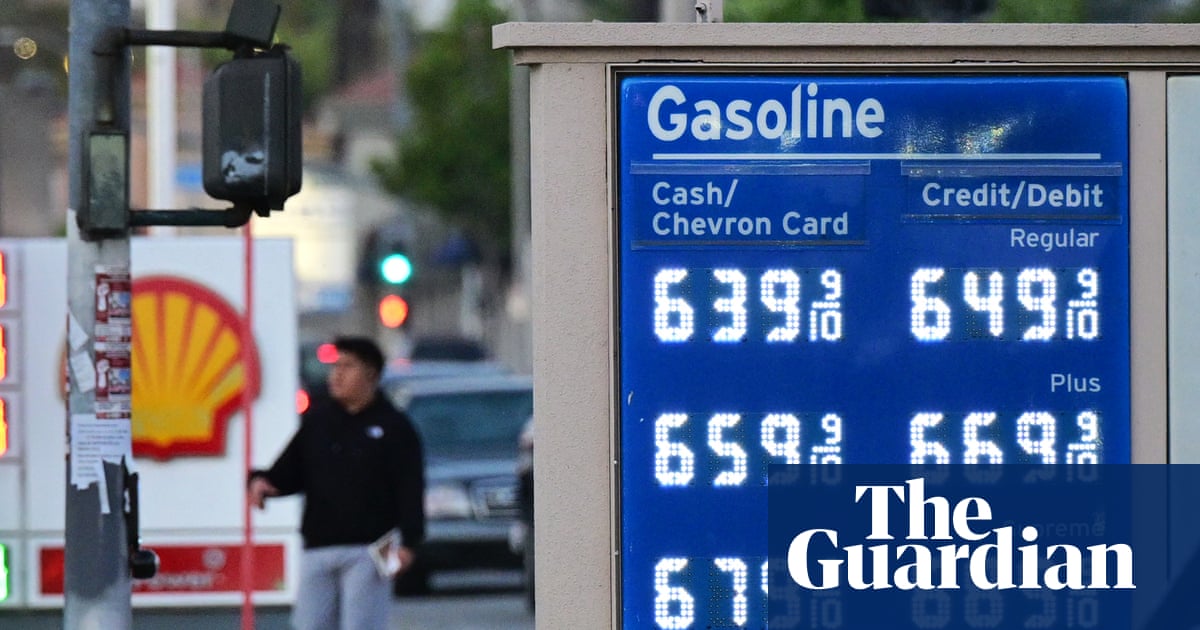
California gas prices are already at $6.16 a gallon, while the national average has risen to $4.54, as the last planned Middle East tanker shipment delivering about 2 million barrels to Long Beach arrives. Officials say the state has roughly six weeks of fuel supply, but California will need new crude sources after imports from the Gulf are disrupted by the war and closure of the Strait of Hormuz. The news signals continued upward pressure on gasoline prices, with low-income consumers hit hardest and broader market volatility easing only after signs of a possible diplomatic deal.
The first-order read is that California is the stress point, but the second-order effect is a regional crack-spread dislocation rather than a simple crude rally. West Coast gasoline inventories are structurally more fragile because replacement barrels must come through longer, thinner logistics chains; that means refiners with Gulf Coast access and inland distribution can outperform even if headline crude prices fade. The market is still underpricing how quickly retail prices can move once the “in-transit” buffer clears — the adjustment can show up within days at the pump, but margin normalization for refiners can persist for 4-8 weeks.
The biggest beneficiaries are upstream producers and refiners outside the affected import corridor, while the losers are California-exposed retailers, delivery fleets, and discretionary consumer names with high mileage exposure. Low-income households are the key transmission channel: they cut volume first, which hurts convenience retail, quick-service traffic, and suburban retail footfall before the macro data fully reflects it. That creates a lagged demand hit that is more relevant for consumer cyclicals than for the energy complex itself.
The market’s current reflex to fade the move on any diplomatic headline is probably too simplistic. Even if shipping risk eases, the replenishment cycle for West Coast supply should keep local product prices elevated for weeks, and inventories cannot be rebuilt instantly without widening basis differentials. The real tail risk is a renewed closure or tanker disruption, which would reprice not just crude but also diesel and jet fuel, amplifying transportation and freight inflation across the next 1-2 months.
The contrarian view is that the headline could be bearish for the broad market but not uniformly bullish for energy: if policymakers accelerate a deal, the near-term crude spike can reverse quickly, while the West Coast gasoline premium may remain sticky. That argues for separating Brent direction from California pump-price exposure — a distinction the market often misses in geopolitical shocks.
AI-powered research, real-time alerts, and portfolio analytics for institutional investors.
Request DemoOverall Sentiment
moderately negative
Sentiment Score
-0.45
