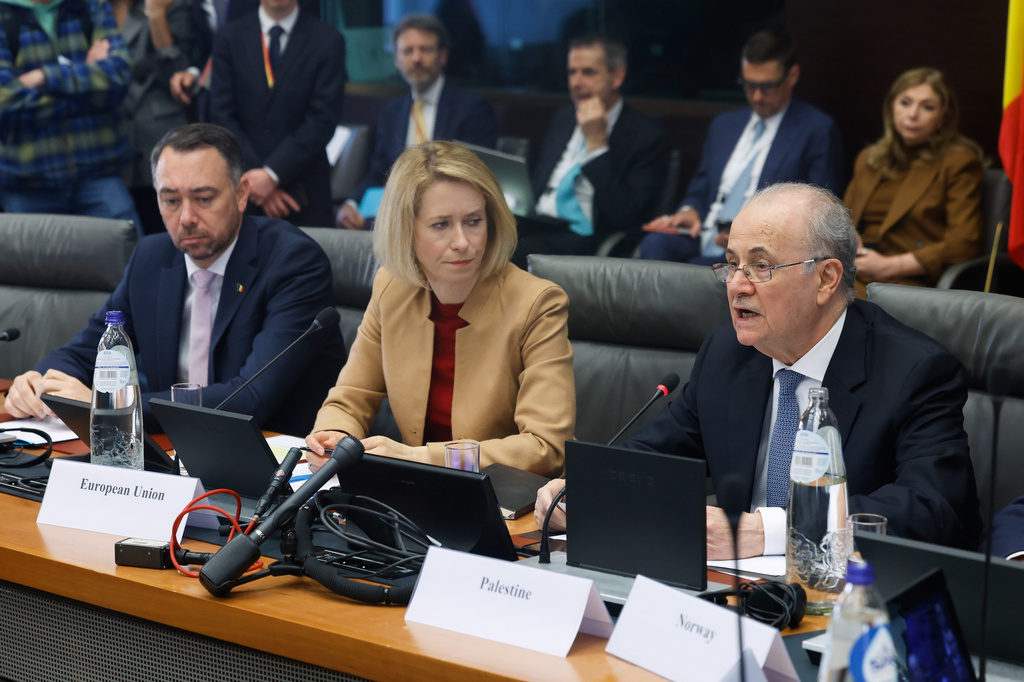
The EU hosted a Palestinian peace conference with more than 60 nations as it seeks a larger role in Gaza and the West Bank, while momentum may improve after Hungary's expected policy shift away from Orbán's vetoes. EU officials said 26 of 27 members favor sanctions on violent Israeli settlers, and Spain will formally propose suspending the EU-Israel Association Agreement, though approval remains unlikely. Palestinian Prime Minister Mohamed Mustafa called for unified governance in Gaza, full Israeli withdrawal, and coordinated security arrangements under the Palestinian Authority.
This is less a near-term market event than a shift in the political option set: Europe is moving from rhetorical discomfort to potentially actionable pressure points on Israel. The key second-order implication is that the lowest-friction tools are not broad trade measures, but narrow, legally cleaner steps such as settler sanctions and procurement scrutiny, which can still reprice defense, ag-tech, and dual-use exporters without requiring unanimity. That means the market should focus on names with EU exposure but limited headline tolerance, not just Israeli domestically exposed assets.
The bigger risk premium is on governance friction in the EU itself. If Hungary stops being a blocking vote, consensus can harden quickly around measures that were previously symbolic; that creates a discrete catalyst window over the next 1-3 months for sector-specific sanctions or compliance tightening. However, the chance of a sweeping suspension of the EU-Israel framework remains low because core-member divergence means the block will likely default to incrementalism, which keeps the trade more about optics and procurement behavior than a full economic decoupling.
The contrarian angle: the market may be overestimating how much policy can change without Washington. The EU can raise transaction costs and reputational risk, but it cannot easily replace US security guarantees or materially alter the ceasefire architecture, so the ultimate economic impact may be modest unless the US aligns. Still, the path of least resistance is a slow bleed: more due diligence, slower approvals, and higher bid-ask spreads for companies with Israeli supply chains or EU public-sector exposure. That creates a better setup for relative-value shorts than for outright macro bets.
AI-powered research, real-time alerts, and portfolio analytics for institutional investors.
Request DemoOverall Sentiment
mildly negative
Sentiment Score
-0.15
