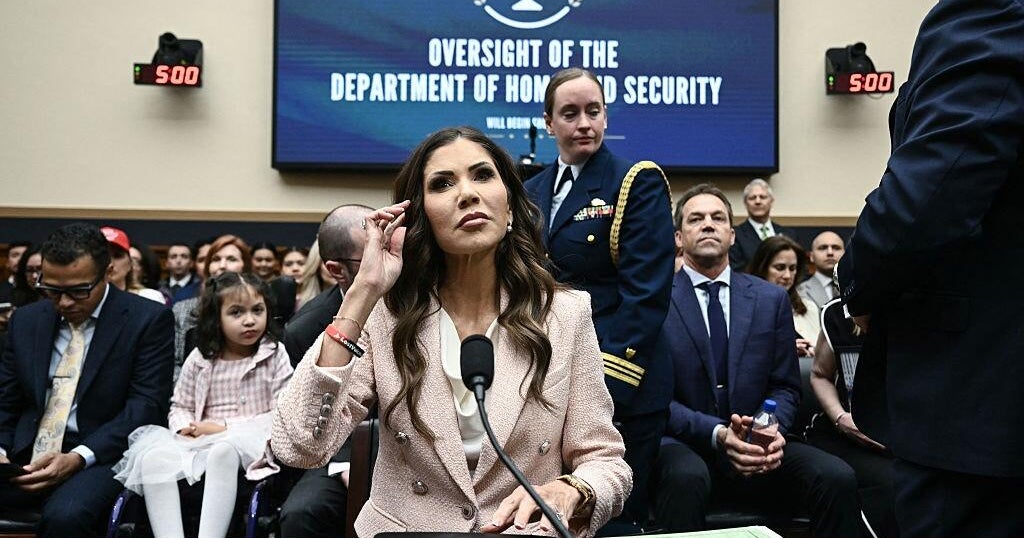
Homeland Security Secretary Kristi Noem testified before the House Judiciary Committee amid intense criticism over her remarks linking two Minnesotans to “domestic terrorism,” the department’s handling of a recent immigration crackdown, and a more than $200 million advertising campaign. The partial DHS funding lapse that began Feb. 14 continues, despite last year’s One Big Beautiful Bill providing $165 billion to DHS (including $75 million earmarked for ICE); Noem said roughly 14,000 body cameras are deployed but that DHS needs “tens of thousands” more and additional funding. Lawmakers from both parties pressed Noem on investigations, potential stonewalling, and management decisions, raising governance and legal risks for DHS operations while producing limited near-term market implications.
Market structure: Political friction around DHS funding and high-profile enforcement actions creates a clear winners/losers split. Near-term winners are homeland-security tech and systems integrators (AXON, LDOS, LHX, PLTR) if Congress earmarks funding for body cameras, data systems and maintenance; current DHS count is ~14,000 cams with “tens of thousands” more needed (implying 30k–70k incremental units over 1–3 years). Losers are exposed consumer-facing service sectors (airlines/JETS ETF) from potential TSA disruptions and reputational/contract risk for private prison operators (CXW, GEO). Cross-asset: expect modest risk-off moves in equities on funding uncertainty, slight safe-haven bids in 2–10y Treasuries if shutdown extends >30 days, and muted FX/commodity impact absent wider geopolitical spillovers.
Risk assessment: Tail risks include a protracted DHS shutdown (>45 days) causing operational failures or state-federal clashes that force abrupt contract cancellations (high impact, <10% probability), and adverse legal rulings or investigations that remove procurement upside. Time horizons: immediate (days) = headline-driven volatility; short-term (4–12 weeks) = appropriations votes/contract RFP flow; long-term (12–36 months) = multi-year procurement and maintenance revenue. Hidden dependencies: federal funding often conditions procurement on maintenance lines and state buy-in; federal ads/PR spend are noise versus line-item appropriations that drive revenue. Catalysts: House/Senate appropriation votes, DHS contract awards, or inspector-general findings on Minneapolis shootings.
Trade implications: Direct: establish a 2–3% portfolio long in AXON (AXON) via 12–18 month LEAP calls and 1–2% long in LDOS or LHX equities to capture systems-integration upside if appropriations include bodycam/IT spend. Short 1–2% positions in CXW and GEO to reflect heightened political & litigation risk; pair trade = long AXON, short GEO (equal dollar). Options: buy 3–6 month AXON call spreads ahead of appropriation windows; buy a 30–90 day put spread on JETS (airline ETF) as a tactical hedge. Timing: initiate options within 30 days, build equities 30–90 days; trim longs if funding is not passed within 90 days or after a +25% move.
Contrarian angles: Consensus treats this as transient political noise; market may underprice procurement upside—if 50k bodycams are funded at $600–$1,500 all-in, addressable revenue across hardware+services could be $30m–$75m/year incremental for vendors over 2–3 years. Conversely, the market may be over-punishing private prisons (CXW/GEO) — if enforcement intensifies and detention bed demand rises, a tactical 0.5–1% long could outperform, but only after confirmed contract awards. Historical parallel: 2018–19 DHS funding cycles produced multi-quarter lifts in defense integrators; unintended consequence risk remains high (investigate contract clauses and liability exposure before sizing).
AI-powered research, real-time alerts, and portfolio analytics for institutional investors.
Request TrialOverall Sentiment
moderately negative
Sentiment Score
-0.35
