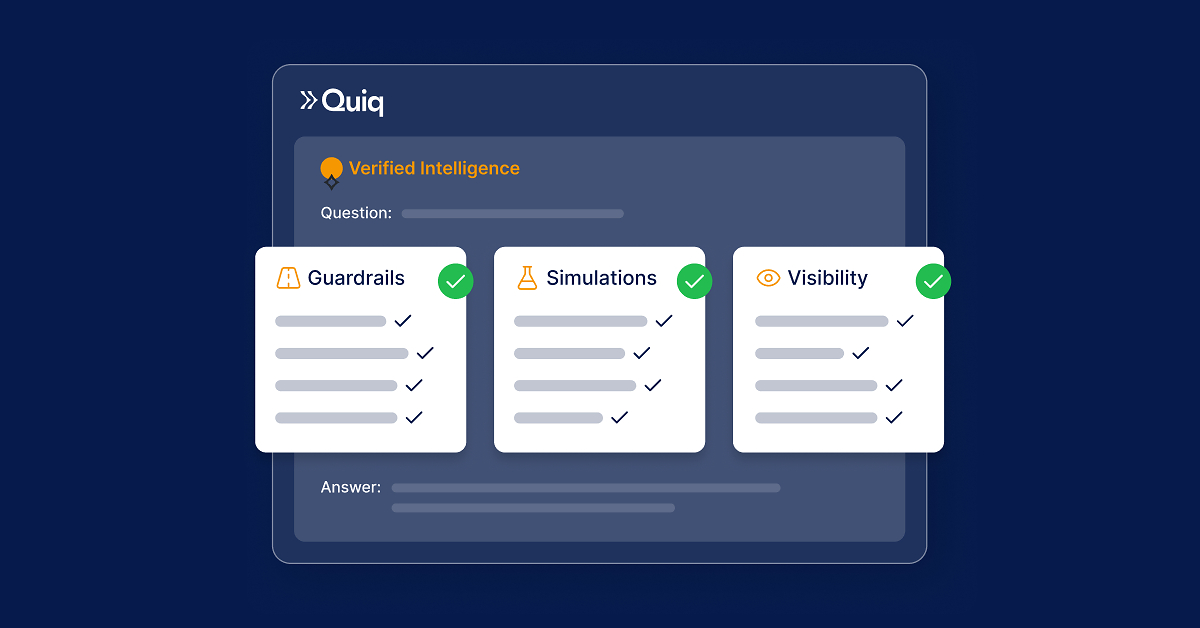
Quiq (agentic AI platform) announced Verified Intelligence, adding a control layer for enterprise deployment: guardrails (Verify Claim accuracy checks + Process Guides), pre-launch simulations running hundreds of multi-turn conversations, and step-by-step decision visibility/auditing. The announcement targets reducing operational and reputational risk when deploying agentic AI, with capabilities available now across the Quiq platform for all AI agent deployments.
This is less a product-launch catalyst than a signal that enterprise AI adoption is moving from experimentation to governance-first procurement. The economically relevant shift is not incremental chatbot capability; it is that large consumer brands will now spend to reduce liability around hallucinations, which should accelerate budget approval for customer-service automation where labor savings have been stranded by legal/brand risk. Over the next 1-3 months, that supports vendors that can position as “safe AI” rather than “cheap AI,” while commoditizing bare-bones conversational agents.
For the named holders, the direct P&L effect is modest, but the operating leverage matters. ROKU and URBN are better positioned than most consumer internet/retail names to benefit from lower support intensity because their customer interactions are frequent, digital, and brand-sensitive; even a small reduction in contact-center load can flow through to margin because the spend is mostly fixed until volume inflects. ACCYY is a slower-burn beneficiary: hospitality is multilingual and service-heavy, so AI governance tools can unlock automation, but the adoption curve is longer and more operationally constrained.
The contrarian point is that the market may overestimate the defensibility of this layer. Step-by-step visibility and simulations are increasingly table-stakes, and if hyperscalers or CCaaS incumbents embed similar controls, standalone vendors may not retain pricing power. The real falsifier is proof of repeatable enterprise conversion: watch for disclosed production rollouts, renewal uplift, or measurable contact-rate reduction; absent that, this is more a tone-positive announcement than an earnings driver. Timeline: immediate stock reaction should fade; the tradable window is 1-3 quarters if verified AI becomes a gating feature in vendor selection, with 6-18 month upside only if it translates into lower service expense or higher conversion.
AI-powered research, real-time alerts, and portfolio analytics for institutional investors.
Request DemoOverall Sentiment
mildly positive
Sentiment Score
0.18
Ticker Sentiment
