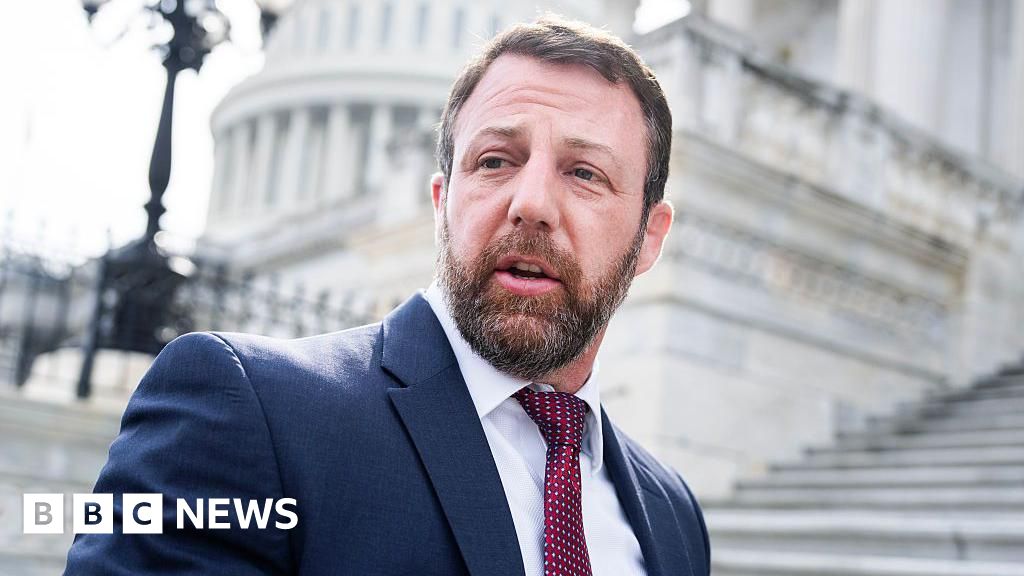
President Trump has announced Oklahoma Senator Markwayne Mullin as his pick for Homeland Security secretary, replacing Kristi Noem; the nomination requires Senate confirmation. Mullin, a first-term senator and vocal supporter of aggressive immigration enforcement, inherits an agency facing funding lapses amid a partial government shutdown and heightened scrutiny after recent fatalities involving federal immigration agents. His combative public persona and stated intent to prioritize border security signal continuity of enforcement-focused DHS policy, while political controversy and budget uncertainty create operational and oversight risks for the department.
Market structure: A Mullin confirmation would bias federal procurement and enforcement toward border security, detention operations, law-enforcement tech and immigration-related services; expect incremental budget tailwinds of $1–5bn/year to prime contractors (LHX, LMT, GD) and surveillance/identity vendors (AXON, CRWD) over 12–36 months if appropriations follow. Private-prison operators (GEO, CXW) see asymmetric political risk — short-term spikes on policy news, medium-term pressure from litigation and reputational damage. Pricing power shifts to incumbents with existing DHS contracts; smaller integrators could be crowded out unless they win niche CISA/cyber roles.
Risk assessment: Tail risks include a failed confirmation (near-term, within 30–60 days) sparking procurement pauses, or high-profile enforcement incidents triggering litigation and congressional clampdowns on private detention — both can move stocks 15–40% within weeks. Hidden dependencies: DHS funding is subject to appropriations and shutdown dynamics; positive procurement thesis collapses if DHS remains underfunded for >90 days. Catalysts: Senate confirmation schedule, FY budget votes (next 3–6 months), and any border incident will accelerate moves.
Trade implications: Favor selective, modest longs in defense/security primes with DHS exposure (LHX, LMT) size 1–3% portfolios with 12–24 month horizon; avoid or short private-prison names (GEO, CXW) 0.5–2% until legal/regulatory clarity, using 20% stop-loss thresholds. Use options: buy 30–90 day straddles around confirmation hearings on high-gamma names (CRWD, PANW) sized 0.25–0.5% for event volatility, and buy 9–12 month LEAP calls on LHX sized 1% to capture multi-year procurement upside.
Contrarian angles: Consensus assumes detention/procurement wins, but markets underprice the probability of increased oversight and funding delays; private-prison stocks may be overvalued by >30% if federal contracts are curtailed. Conversely cybersecurity contractors are under-owned relative to downside risk in government networks — an underappreciated, durable revenue stream over 2–3 years. Historical parallel: prior DHS leadership changes produced 10–25% re-rating in mid-cap contractors within 6–12 months, not immediate large-cap moves.
AI-powered research, real-time alerts, and portfolio analytics for institutional investors.
Request DemoOverall Sentiment
neutral
Sentiment Score
0.00
