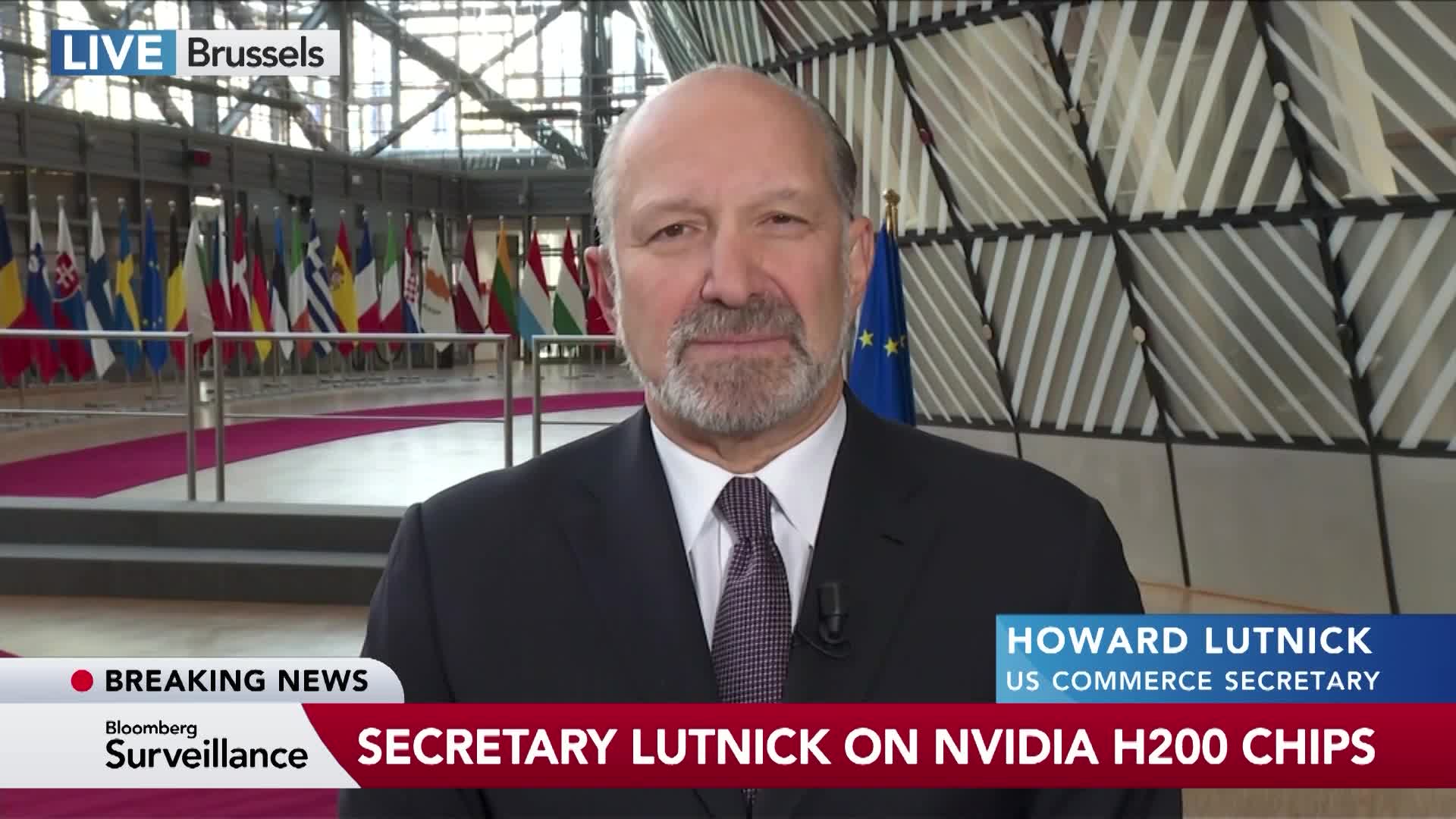
Ryan Lutnick flagged that a presidential decision by Donald Trump will determine whether Nvidia's high-end H200 AI accelerator chips can be shipped to China, making the White House the pivotal actor on this key export-control issue. The outcome will affect Chinese access to top-tier AI compute, Nvidia's exposure to the China market and the broader semiconductor supply chain, so investors should monitor any administration rulings as they could materially influence sector revenue and supply dynamics.
Market structure will bifurcate: if exports are allowed NVDA regains pricing power on next-gen H200s and can keep FY revenue growth 20%+ higher vs a ban scenario; if blocked, Chinese demand shifts to AMD (AMD), domestic chipmakers, and cloud procurement, compressing NVDA's China revenue by an estimated 5–10% of total over 12 months. Restricted supply of top-tier accelerators will push spot/secondary market prices and HBM memory demand higher, raising short-term margins for remaining suppliers and increasing NVDA implied volatility ~20–40% around the decision window. Across assets, a ban increases downside risk for NVDA equity and raises semicap bond spreads modestly (50–150bps) while pressuring CNY and boosting safe-haven Treasury demand.
Tail risks include a full multi-year embargo (severe, >30% revenue hit for NVDA), immediate Chinese retaliation on U.S. cloud or rare-earth exports, or rapid domestic substitution funded by RMB sovereign support; any of these would reorganize share leadership over 2–36 months. Near term (days) expect IV and directional moves; short-term (weeks–months) see order-book reallocation and capex revisions by cloud providers; long-term (years) the structural winner depends on China's ability to indigenize HBM, packaging, and software stack. Hidden dependencies: Nvidia’s ecosystem exposure (driver, software, cloud partnerships) and HBM/supplier concentration (TSMC/Samsung) create choke points beyond chip export paperwork. Catalysts to watch: formal Commerce guidance, a presidential memo, NVDA earnings guidance, and Chinese public procurement announcements.
Trade implications: conditional directional trades on NVDA and relative-rotation into AMD, AMZN, GOOGL, and LRCX are highest-conviction. Use option structures to express binary outcomes: buy 30–60 day straddles into the decision for IV capture, and favor call spreads if approval odds >60% or put spreads if denial is signaled. Reallocate 1–3% tactical sleeve from EM/China equities into US cloud and select semicap names for 3–12 month resilience.
Contrarian angles: the market tends to price either full access or full decoupling; reality likely lands in the middle and the revenue hit to NVDA may be under 10% annualized if workarounds and prior-generation H100s remain tradable. Historical precedent (Huawei sanctions) shows short-term disruption but long-term adaptation and limited permanent share loss for entrenched incumbents. An unintended consequence of a ban is an accelerated Chinese capex program that could create multi-year demand for non-US tooling and memory suppliers, presenting alternate winners not currently in consensus.
AI-powered research, real-time alerts, and portfolio analytics for institutional investors.
Request DemoOverall Sentiment
neutral
Sentiment Score
0.00
Ticker Sentiment
