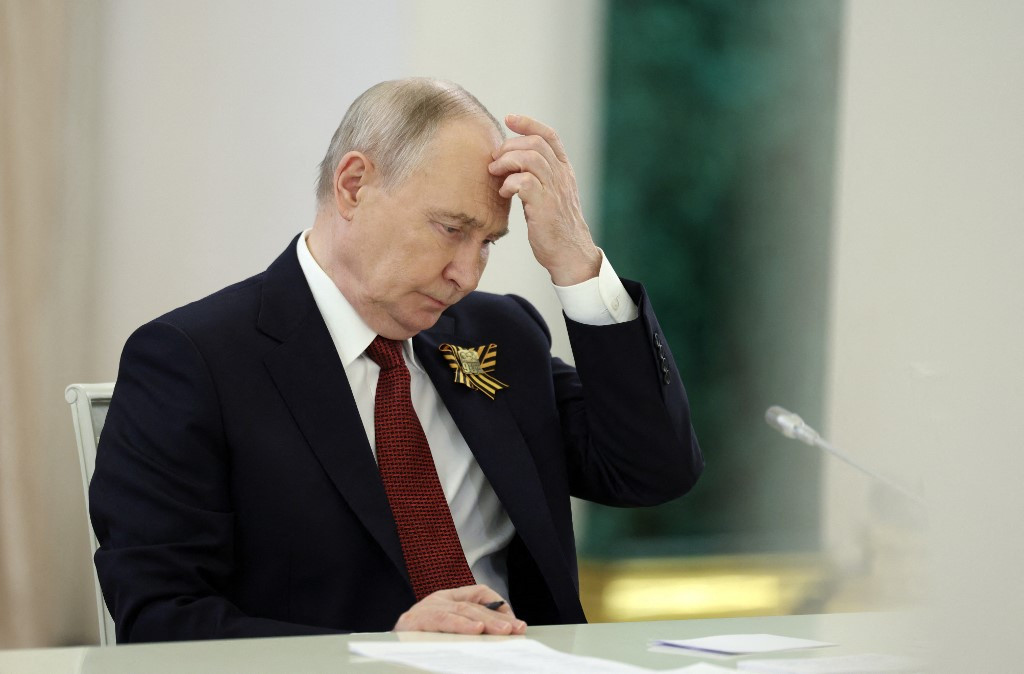
The article highlights a worsening Russia-Ukraine war dynamic: Russian casualties per square kilometer seized reportedly surged more than 8,700% from January to March, while Moscow faces a manpower deficit of roughly 200 recruits per day versus battlefield losses of up to 35,000 a month. It also cites a 97% rise in Russian billionaire wealth since the war began and says over 90% of nationalized property has been transferred to Putin-linked elites, suggesting the conflict is enriching insiders even as military strains intensify. The piece warns of potential escalation through forced mobilization, terror tactics, and further attacks on Ukraine’s infrastructure and energy assets, making the outlook highly destabilizing.
The investable signal is not the battlefield headline; it is the tightening loop between labor scarcity, coercive mobilization, and state capture of cashflows. Once a regime shifts from paying for a professional war to extracting bodies from the periphery, the marginal “cost” of each additional month rises nonlinearly: logistics degrade, absenteeism rises, and domestic repression becomes a substitute for operational efficiency. That typically shows up first in higher FX leakage, then in local banking stress, and only later in visible front-line weakness. The second-order winner-set is narrower than it looks. Defense, surveillance, telecom monitoring, prison/security-adjacent systems, and dual-use electronics intermediaries benefit from a more authoritarian equilibrium, while civilian industrial names, consumer lenders, regional banks, and anything reliant on cross-border settlements become structurally weaker. Energy remains the key swing factor: damaged refining and upstream infrastructure can support near-term prices, but a prolonged coercive mobilization regime also raises the probability of discretionary demand destruction inside Russia and greater discounting on sanctioned barrels. The market is probably underestimating the speed at which internal stress can translate into policy discontinuity. The base case is not a clean collapse; it is a messy sequence of tighter capital controls, harsher mobilization, and selective elite asset stripping over the next 1-3 quarters. The tail risk is that a sudden legitimacy shock or elite split forces an abrupt stop-loss event in risk assets most exposed to Russian supply chains, sovereign spreads, or neighboring-country energy transit. A key reversal catalyst would be a credible external financing/off-ramp package paired with sanctions relief, but that requires political conditions that currently look remote. Contrarianly, consensus may be overpricing the idea that more mobilization equals more military power. A low-quality manpower surge usually buys time, not decisive capability, and can accelerate regime fragility by putting stress on households, budgets, and regional elites. The more durable trade is to own the assets that profit from disorder management and to fade names that depend on a stable Eurasian trade architecture or uninterrupted Russian hydrocarbon output.
AI-powered research, real-time alerts, and portfolio analytics for institutional investors.
Request DemoOverall Sentiment
strongly negative
Sentiment Score
-0.82
