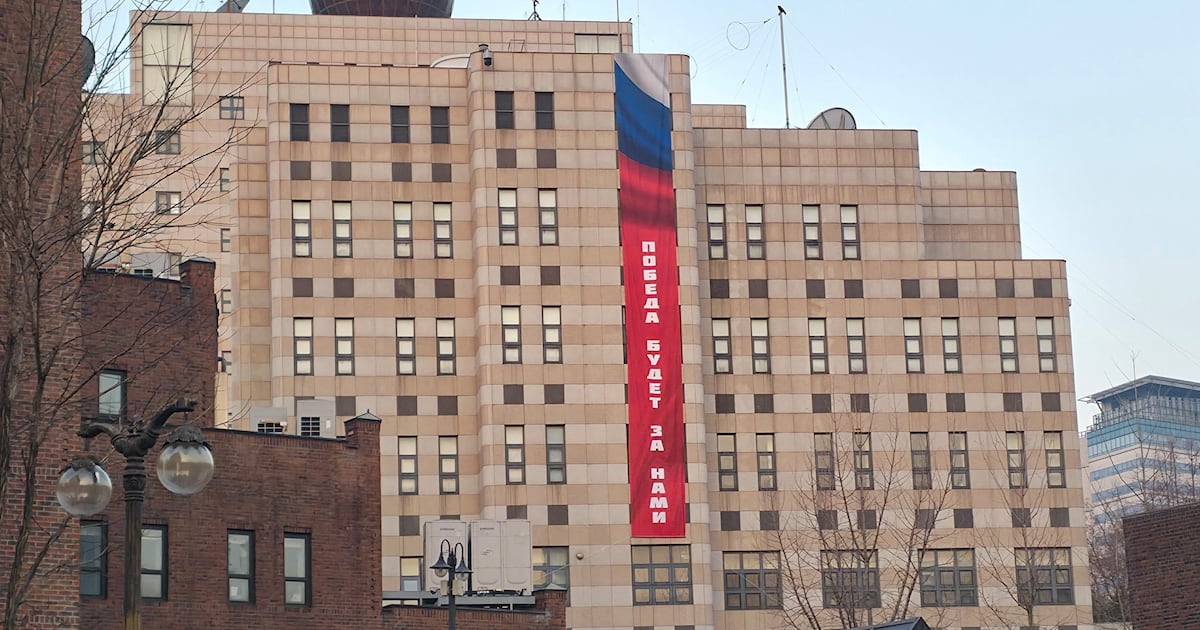
The Russian Embassy in Seoul refused South Korean requests to remove a pro-war banner, openly defying local authorities and raising diplomatic tensions between Moscow and Seoul. While the incident is primarily political and symbolic, it increases short-term geopolitical risk in the region and could prompt legal responses or reciprocal measures; market impact is likely limited but may modestly raise risk premia for regional assets and attract attention to defense and political-risk-sensitive sectors.
Market-structure: The immediate winners are defense primes (LMT, RTX, NOC), safe-havens (GLD, TLT) and FX pairs favoring USD/JPY and USD/KRW; losers are Korea equity beta (EWY), Korea-listed consumer and travel names, and logistics firms with Russia exposure. Pricing power shifts modestly toward governments/defense contractors (expected bid pipelines up 5–15% in short windows) while Korean exporters face transitory risk-premia widening. Cross-asset: expect a 1–3% knee-jerk KOSPI decline, KRW weakness of 1–2% intraday, +1–2% gold and +5–10bp widening in KOR sovereign CDS if rhetoric escalates.
Risk assessment: Tail risks include cyber retaliation, targeted sanctions on Korean firms, or reciprocal expulsions that could disrupt trade; although low probability (<10%), impact could be high (5–10% GDP-equivalent trade shock for specific sectors). Immediate (days) effects: volatility spikes and safe-haven flows; short-term (weeks–months): diplomatic tit-for-tat and potential trade frictions; long-term (quarters–years): supply-chain reconfiguration and permanent defense budget reallocations. Hidden dependencies: semiconductor supply chains (neon/industrial gas links) and shipping routes could amplify micro impacts beyond headline diplomatic noise.
Trade implications: Tactical trades: small defensive longs (1–2% portfolio each) in LMT and RTX; buy 3-month EWY 5% OTM puts sized at 1–2% notional or short 2–3% EWY outright as hedge. Pair trade: long LMT (1%) / short EWY (2%) to capture relative re-rating if tensions persist; buy GLD (1–2%) or 2–3yr protection via TLT (1%) if KOSPI drops >2% or USD/KRW crosses 1,330. Options: buy 30–90 day USD/KRW call options or EWY puts—target IV-rich windows; exit on two-week de-escalation or KOSPI recovery >5%.
Contrarian angles: Markets often overshoot: past Korea-related geopolitical spikes normalized in 4–12 weeks, so deep, multi-month EWY shorts are risky. Consensus misses selective buying opportunities in high-quality Korean exporters with negligible Russia exposure (e.g., SSNLF/005930.KS equivalents) after >8–12% drawdowns. Unintended consequences: a temporary surge in defense contractor shares could reverse if budgets don’t materialize; avoid levering beyond 3x on geopolitical thematic trades.
AI-powered research, real-time alerts, and portfolio analytics for institutional investors.
Request DemoOverall Sentiment
moderately negative
Sentiment Score
-0.40
