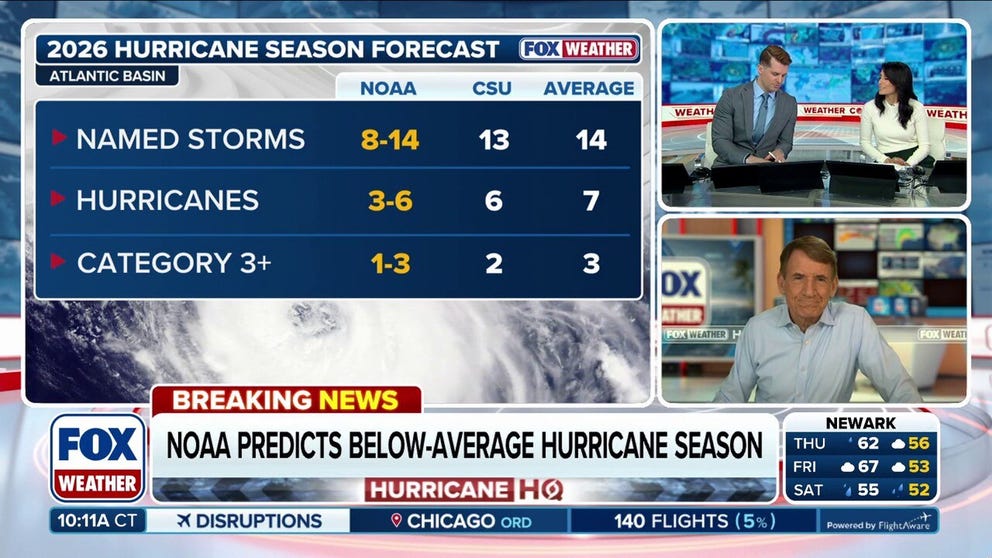
NOAA’s 2026 Atlantic hurricane forecast calls for a below-average season with 8 to 14 named storms, 3 to 6 hurricanes, and 1 to 3 major hurricanes, versus a historical average of 14 named storms, 7 hurricanes, and 3 major hurricanes. The agency says a developing Super El Niño should suppress Atlantic storm formation, though it may still permit shorter-lead-time homegrown systems in the Gulf and along the Southeast coast. The update is mainly risk-assessment news rather than a direct market catalyst, but it is relevant for insurers, travel, coastal infrastructure, and logistics planning.
The market implication is not “less hurricane risk,” but a rerouting of risk from broad seasonal dispersion into a narrower set of event-driven winners and losers. A suppressed open-ocean season reduces the probability of prolonged nationwide disruption, yet raises the relative importance of short-fuse coastal storms that create the most operational whiplash for insurers, ports, and near-shore logistics because response times are shorter and damages are harder to pre-hedge.
The second-order effect is on supply chains and regional capacity utilization: fewer long-track storms should support Gulf refinery uptime, port throughput, and construction schedules, but a single landfalling system still creates localized bottlenecks that can spike spot trucking, rail intermodal, and generator demand for 1-3 weeks. For consumer and industrial names with Southeastern concentration, the risk is not total seasonal losses but inventory timing, labor disruption, and margin pressure from expedited freight and temporary shutdowns.
The contrarian angle is that the market may over-interpret a benign forecast as a reason to discount catastrophe exposure entirely. If the suppressive pattern forms later than expected, the first half of the season can still produce high-impact, low-warning storms; that asymmetry favors owners of optionality over linear hedges. In practice, the best risk/reward is in buying cheap event protection now, before the implied volatility reprices on a single early storm track.
AI-powered research, real-time alerts, and portfolio analytics for institutional investors.
Overall Sentiment
mildly negative
Sentiment Score
-0.15
