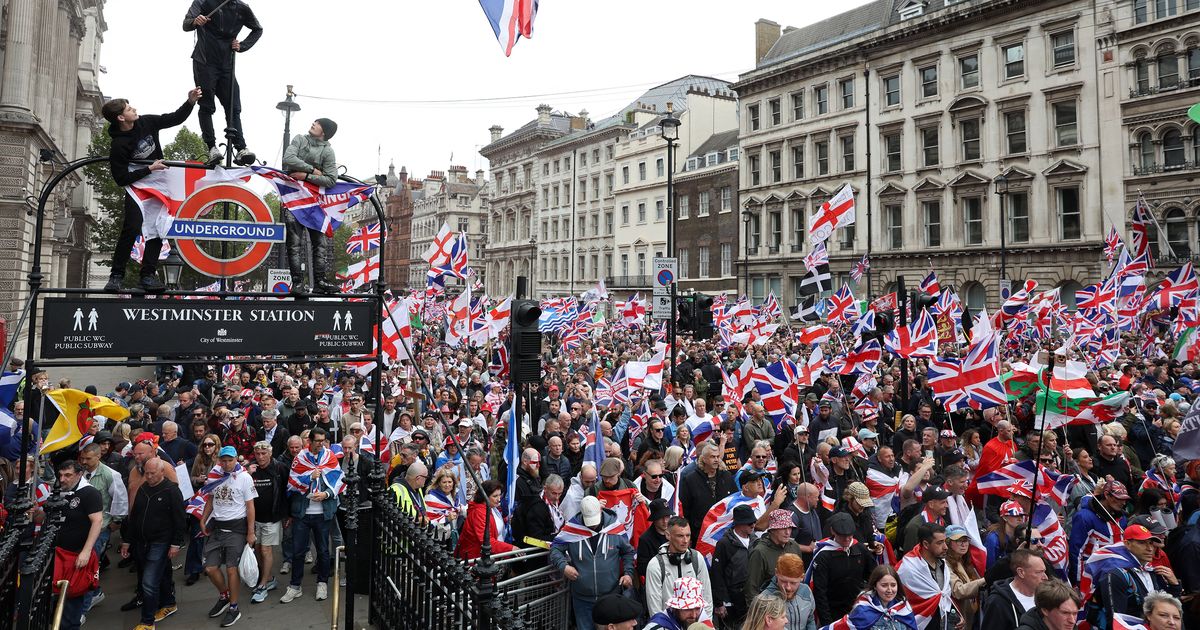
London saw two major protests on Saturday, with more than 4,000 police deployed in an 'unprecedented in recent years' operation amid fears of clashes between far-right and pro-Palestine marchers. Authorities made 11 arrests by 1 p.m., and the U.K. government banned 11 foreign far-right agitators ahead of the demonstration. The article highlights rising hate-crime and terrorism concerns, but it is primarily a public-order and security issue rather than a direct market-moving event.
The immediate market read-through is not broad beta but microstructure: a concentrated security event of this scale tends to pull staffing, transit, retail, and event logistics into overtime cost and disruption without creating a durable macro shock. The bigger second-order effect is reputational and policy pressure, which increases the odds of tighter public-order rules, more surveillance spend, and a higher baseline security burden for venues, transport operators, and city-center retailers over the next 3-12 months.
For consumer-facing names exposed to London footfall, the risk is less about one weekend’s lost sales and more about a short-term deterrence effect on discretionary city-center traffic if headlines of unrest repeat. That matters most for hotels, restaurants, luxury retail, and transit-linked concessions with high weekend sensitivity; even a low-single-digit traffic hit can compress near-term comps because fixed-cost leverage is high. Conversely, security vendors and facial-recognition / monitoring infrastructure suppliers gain a stealth tailwind as police and private operators justify incremental capex and service contracts.
The contrarian view is that markets may overestimate the persistence of unrest as an investable theme. If the weekend passes with limited violence, the event becomes a one-off headline rather than a trend, and any “London risk premium” in hospitality and retail can fade quickly within days. The real medium-term catalyst is not protest intensity itself but whether officials respond with more restrictions on demonstrations and more spending on public-order technology, which would be incremental positive for defense-adjacent security names.
Tail risk is a single violent incident that triggers a broader escalation in hate-crime rhetoric and a heavier police posture for weeks, which would amplify disruption to transport and retail and could pressure consumer confidence in the U.K. urban core. That would likely matter more for domestically oriented UK equities than for large-cap multinationals, which can absorb local weakness. The market should watch Monday traffic data, transit disruption, and official language on protest restrictions as the highest-signal near-term indicators.
AI-powered research, real-time alerts, and portfolio analytics for institutional investors.
Request DemoOverall Sentiment
mildly negative
Sentiment Score
-0.20
