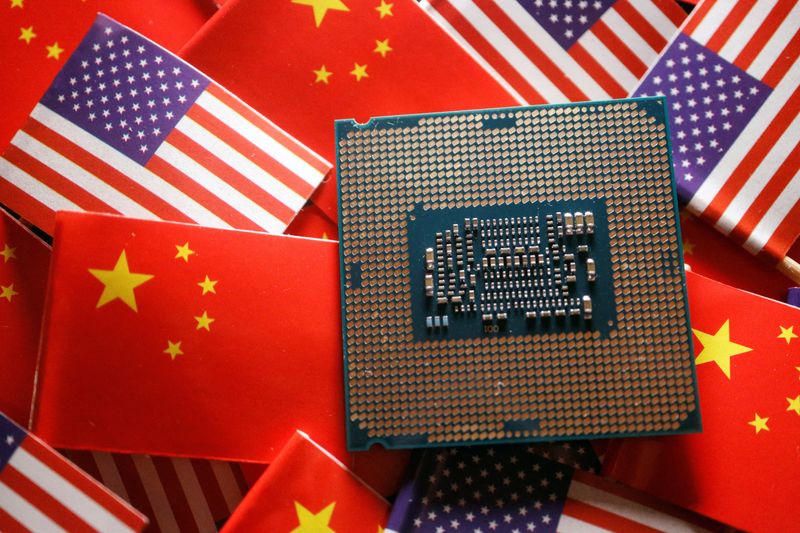
Beijing warned that proposed U.S. bipartisan export-control bills targeting semiconductors and advanced AI/chip hardware could severely disrupt global supply chains. The measures would tighten restrictions on high-end chip-making equipment and deepen the risk of U.S.-China tech decoupling, with possible retaliation from Beijing including curbs on rare earth inputs. The news is negative for semiconductor and hardware supply chains and could move the sector broadly.
The market is underestimating how quickly export controls can shift from a headline risk to an earnings-risk for the equipment layer, while simultaneously becoming a margin tailwind for the most protected domestic analogs and substrate/packaging names. The first-order hit is on China-exposed capex demand, but the second-order effect is a longer procurement cycle globally as fabs pre-buy critical tools and spares to de-risk policy whiplash, which can temporarily support orders before a sharper air pocket later. That means the near-term winners are not the obvious AI semis, but the suppliers with low China revenue and irreplaceable process-node exposure.
The bigger risk is not immediate unit volume loss; it is forced redesign of supply chains over 12-24 months. If Beijing retaliates with rare earths, specialty chemicals, or wafers-related inputs, the pain propagates into packaging, power management, and industrial automation before it reaches headline GPU names. In that scenario, the most vulnerable stocks are the ones priced for uninterrupted AI capex growth but with fragile gross-margin assumptions and long inventory turns.
Consensus is likely overreacting to the rhetoric on the downside for the broad semiconductor complex, but underpricing the dispersion it creates. A policy escalator helps domestic-capacity and localization beneficiaries, yet it also raises the probability that hyperscalers diversify spend across more vendors and geographies, limiting winner-take-all economics. The best setup is to own policy-insulated enablers while fading the most China-dependent capital-equipment and networking names on rallies.
Catalyst timing matters: Congressional action can move in days, but earnings revisions will take 1-2 quarters to show up, creating a window where implied volatility is cheap relative to realized policy risk. A negotiated softening would require visible concessions or a broader trade truce; absent that, the bias remains toward incremental restrictions and retaliatory noise. The trade is less about predicting a single bill and more about positioning for a prolonged regime of higher friction and lower supply-chain efficiency.
AI-powered research, real-time alerts, and portfolio analytics for institutional investors.
Request DemoOverall Sentiment
moderately negative
Sentiment Score
-0.45
