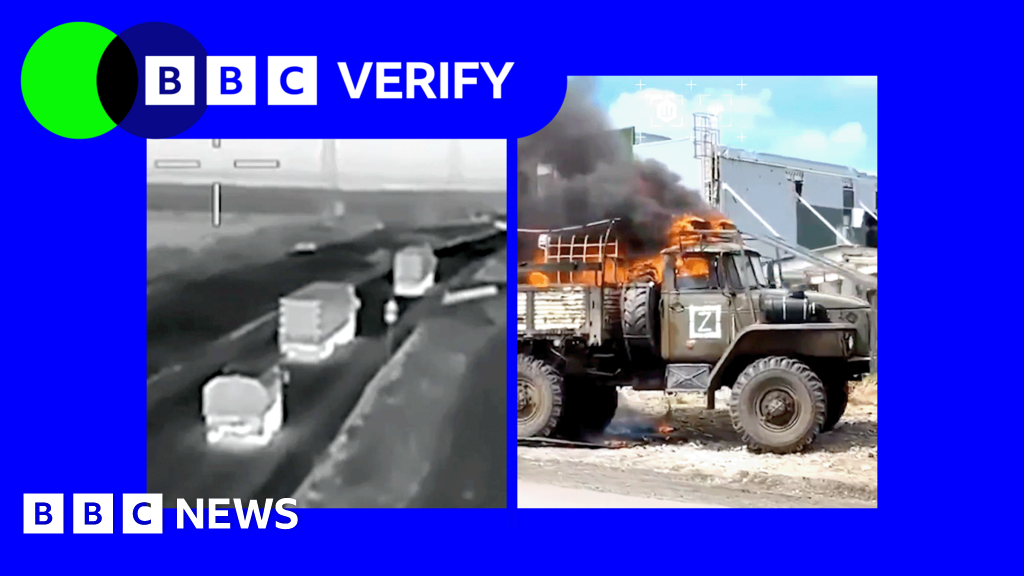
Ukraine is using AI-enabled Hornet drones to target Russian supply convoys, with BBC Verify confirming at least 14 incidents in the past week and analysts citing 150 destroyed vehicles more than 20 km from the front line. The campaign is disrupting logistics routes to Crimea and occupied southern Ukraine, forcing Russia to shorten convoys and move heavy equipment more cautiously. While the article is primarily military in nature, it suggests a meaningful battlefield and defense-technology development with broader geopolitical implications.
The investable signal is not the battlefield headline but the asymmetry in adaptation speed. Small, AI-assisted loitering munitions reduce the marginal value of massed logistics, which means the first-order loser is any force structure optimized around centralized depots, long truck convoys, and predictable road corridors. Second-order, that pressures armor-heavy operations more than infantry-heavy ones because fuel and ammunition become the binding constraint before manpower does.
For public markets, the cleanest implication is a relative benefit to Western drone, sensing, EW, and battlefield software vendors versus legacy heavy-defense primes whose revenue is tied to platform replacement cycles rather than rapid attritable systems. The broader defense supply chain also benefits from higher demand for batteries, edge compute, secure comms, and tactical ISR components; the bottleneck shifts from steel and engines to electronics and software integration. Transportation and logistics names with exposure to contested regions face a tail risk premium if investors start discounting route reliability, especially where rerouting is expensive or insurance is repriced.
The key risk is counter-adaptation: Russia only needs to improve convoy concealment, decoys, EW, or dispersion enough to cut the kill rate materially, and that can happen faster than procurement cycles suggest. That makes the edge more likely to persist for months than years, not permanently. The contrarian miss is that “AI drone advantage” may be less about autonomous tech superiority and more about a temporary operational window created by weak Russian countermeasures; if so, the equity upside is in enablers with repeat procurement, not one-off battlefield winners.
Watch for a lagged shift into defensive systems procurement if this campaign scales—short-range air defense, electronic warfare, and anti-drone interceptors should see budget priority within 1-2 quarters. The broader strategic implication is that logistics interdiction can create local battlefield paralysis without a conventional breakthrough, which historically forces the under-supplied side into either withdrawal or riskier offensive behavior. That raises the probability of sharp, non-linear headlines rather than a smooth trend, making options preferable to outright directional equity bets.
AI-powered research, real-time alerts, and portfolio analytics for institutional investors.
Request TrialOverall Sentiment
neutral
Sentiment Score
0.05
