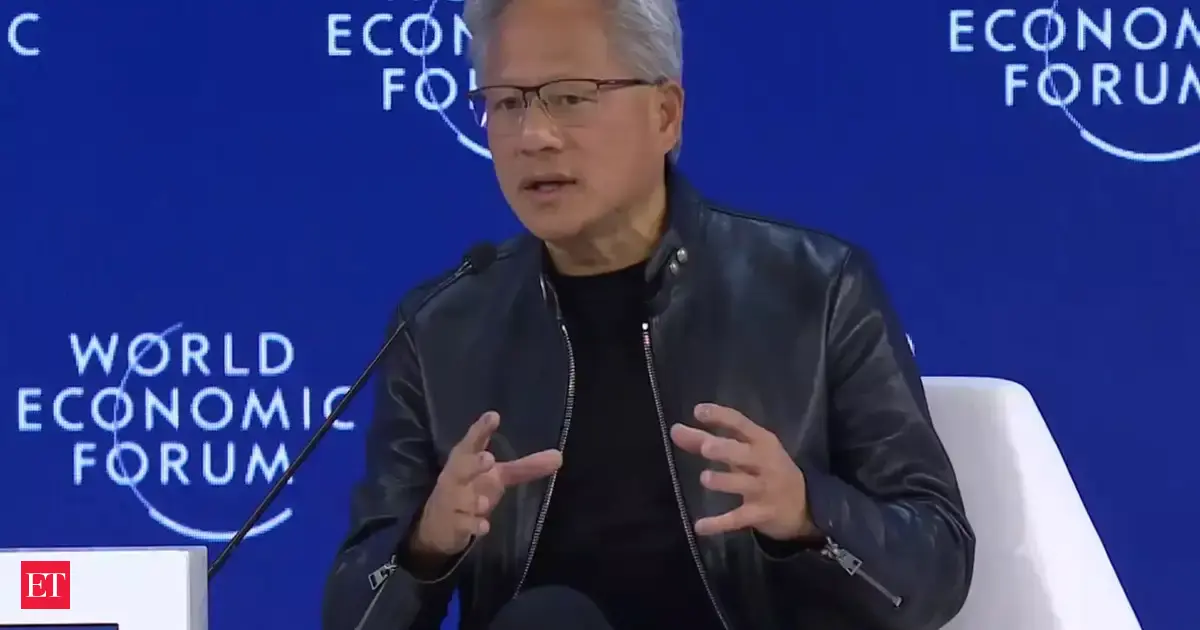
Jensen Huang said parents should not worry about pursuing AI-proof degrees, arguing that AI will automate routine tasks while increasing the value of human skills like storytelling, journalism, design, and live communication. He emphasized that students should use AI to elevate their learning, craft, and purpose rather than avoid it. The message is broadly optimistic for long-term AI adoption and human-AI complementarity, but it is largely commentary and unlikely to move markets directly.
The more important read-through is that NVDA is trying to expand the AI market from a developer/tool buyer into a broad consumer and institutional productivity budget. That matters because it shifts demand from a cyclical capex debate into a longer-duration software/education/workflow adoption curve, which can support inference utilization even if enterprise training spend normalizes. The second-order winner is the ecosystem around AI-enabled productivity: cloud, collaboration, and education software vendors that can monetize usage rather than one-time licenses.
The market is still underestimating how much AI redistributes work rather than destroys it. If AI removes 20-30% of routine tasks in white-collar roles, firms typically redeploy that capacity into output expansion, which raises compute consumption per employee over time instead of lowering it. That dynamic is structurally bullish for NVDA, but the bigger near-term upside may actually sit in companies that sit between model capability and end-user workflow, where adoption can compound without needing perfect consumer sentiment.
The contrarian risk is that the narrative is more durable than the timing. Education and “human skills” framing are supportive, but monetization lags by 6-18 months and could disappoint if enterprises treat AI as a cost-cutting tool first, not a growth lever. In that case, the market may keep rewarding NVDA on headline AI demand while punishing adjacent software names that fail to show measurable seat expansion, retention, or ARPU lift.
A subtle negative for lower-quality content and generic SaaS: if AI improves communication and creation, differentiation shifts toward distribution, brand, and proprietary data rather than feature parity. That widens the gap between platform winners and middle-tier vendors, creating a barbell outcome where the best-in-class capture value and the rest face pricing pressure.
AI-powered research, real-time alerts, and portfolio analytics for institutional investors.
Request DemoOverall Sentiment
mildly positive
Sentiment Score
0.15
Ticker Sentiment
