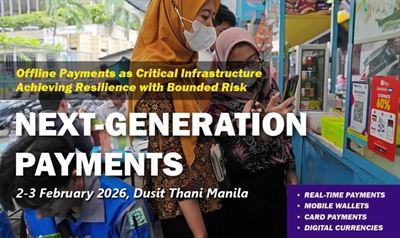
Crunchfish will present its governed offline payments solution at Next Generation Payments 2026 in Manila, with CEO Joachim Samuelsson delivering a presentation and panel on offline payments as critical infrastructure. The company will demo a Layer-2 Reserve–Pay–Settle approach (produced with partner AltPayNet) that enforces local risk parameters while leaving ledger authority and settlement unchanged, targeting banks, payment services and CBDC projects for improved resilience during connectivity outages. Crunchfish is listed on Nasdaq First North Growth Market, headquartered in Malmö with a subsidiary in India.
Market structure: The demonstration tightens focus on “offline payments” as a distinct, investable sub-theme within payments infrastructure — winners are protocol/platform providers and network partners able to embed Layer‑2, governed offline logic (large-cap network owners Visa MA, Mastercard V; mid‑cap acquirers FIS FIS, FISV). Losers are consumer apps and regional wallets that cannot guarantee availability offline or that rely on always‑on rails; expect modest share shifts in EM retail volumes (5–15% potential reallocation over 2–3 years). Cross‑asset: improved revenue visibility for strong processors should modestly tighten credit spreads (10–30bps) and be supportive for USD‑pegged EM FX where payments frictions currently depress flows.
Risk assessment: Tail risks include a high‑profile security/settlement failure (one event could wipe >25% off a small‑cap vendor and cause regulatory moratoria), or regulatory demands that shift liability to central banks/vendors. Immediate impact (days) is negligible; short term (weeks–6 months) RFP/pilot wins drive 10–40% moves in small caps; long term (12–36 months) material adoption can rebase revenue curves for networks. Hidden dependencies: secure element availability, handset OEM cooperation, and settlement law; catalysts are CBDC pilots and Visa/Mastercard adoption timelines.
Trade implications: Tactical allocations: 1–2% longs in MA and V (12‑month horizon, target +12–20%, stop ‑8%), 1% in FIS/FISV for backend capture, and a 0.5–1% high‑risk position in Crunchfish (Nasdaq First North listing) as a binary play (exit if no pilot/contract within 12 months). Options: buy 9–12 month call spreads on MA (10%–30% OTM) to cap cost while capturing adoption upside. Entry: scale in over 4–12 weeks around conference follow‑through and official pilot announcements.
Contrarian angles: Consensus underestimates operational/regulatory friction — adoption may follow an M‑shaped curve (fast pilots, slow rollouts) similar to M‑Pesa adoption taking years to monetize; small‑cap valuations are binary and likely overdone on hype. Unintended consequences include liability disputes between issuers and device OEMs and potential fragmentation if proprietary offline solutions proliferate, which favors incumbents that standardize the stack rather than niche vendors.
AI-powered research, real-time alerts, and portfolio analytics for institutional investors.
Request DemoOverall Sentiment
mildly positive
Sentiment Score
0.28
