
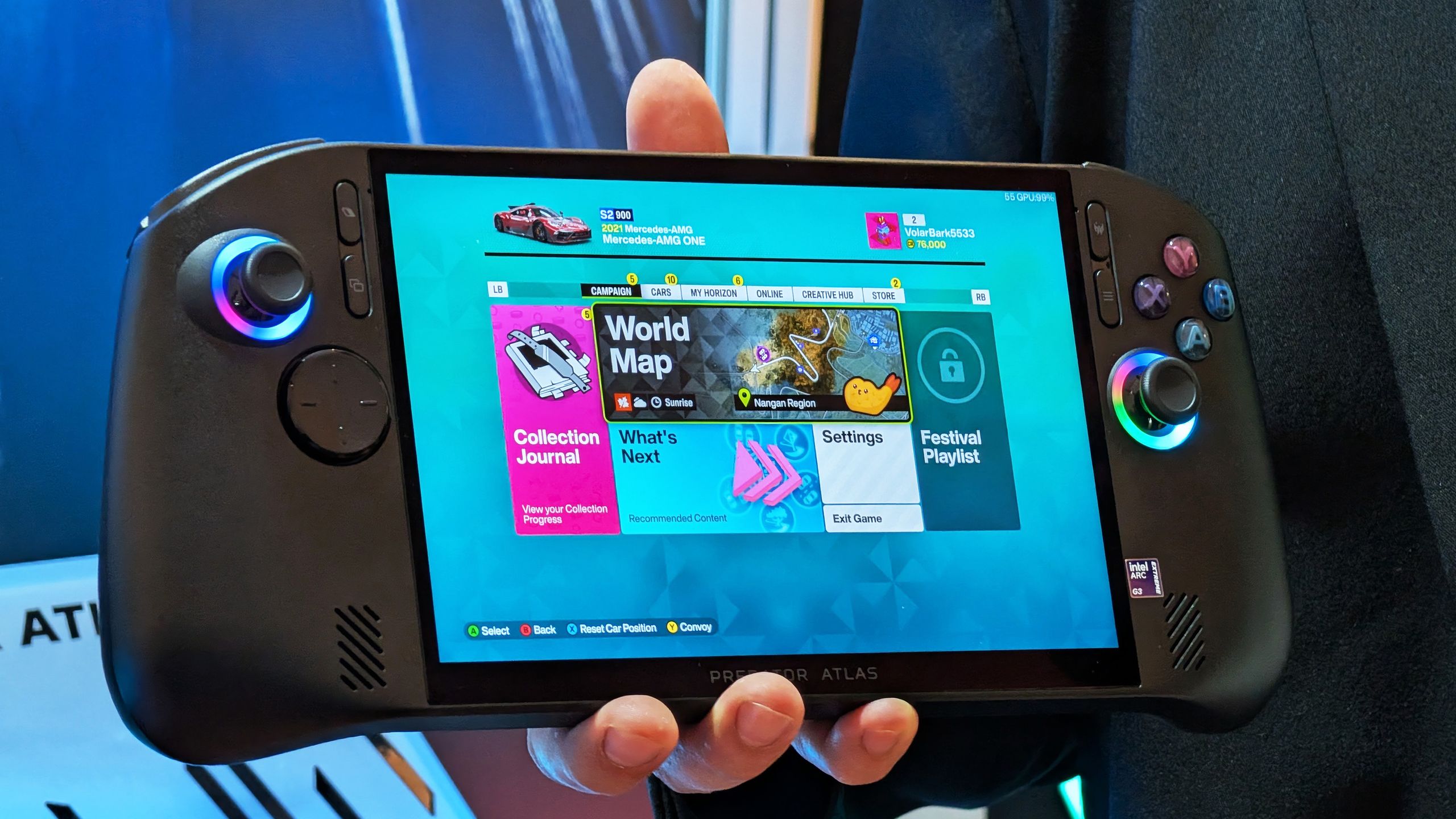
Acer unveiled the Predator Atlas 8 handheld gaming device at Computex 2026, with launch expected in October 2026 across North America, Australia, and EMEA. Key specs include an 8-inch 120Hz FHD+ touchscreen, up to Intel Arc G3 Extreme graphics, up to 24GB LPDDR5X memory, and up to 1TB SSD storage, plus two months of Xbox Game Pass Premium. The news is positive for Acer's gaming hardware push but lacks pricing, so near-term market impact should be limited.
This is less about a single handheld and more about Intel trying to prove it can participate in a premium Windows gaming category where battery life, thermals, and driver stability matter more than raw peak silicon specs. If Acer can ship a credible first-gen device with a major OEM badge, it expands Intel’s addressable narrative from “laptop CPUs” into a higher-margin consumer form factor that could improve attachment rates for its graphics stack and AI-upscaling ecosystem over time.
The second-order winner is likely the channel ecosystem, not just the chip vendor: handheld PCs drive incremental demand for compact SSDs, LPDDR5X, Wi-Fi modules, cooling subassemblies, and display components, but they also commoditize the hardware pretty fast. That means the launch is bullish for Intel only if it pulls forward developer optimization and ecosystem adoption; otherwise, the economic value accrues to whichever vendor can bundle services, subscriptions, and accessories most effectively.
The main risk is that handheld demand remains novelty-driven and highly price elastic. A premium spec sheet helps launch buzz, but adoption can fade quickly if MSRP lands too close to the category leader or if Windows handheld UX still feels rough versus console-like alternatives; that would cap the volume ramp at a few quarters rather than a durable multi-year category expansion.
Contrarian angle: the market may be underestimating how much of Intel’s upside here is optionality rather than near-term earnings. Even a modestly successful launch can shift sentiment on Intel’s consumer graphics credibility, but the P&L impact likely stays small unless Acer’s device is followed by multiple OEM designs and meaningful software optimization gains. The trade is therefore more about narrative inflection and ecosystem validation than handset unit volume alone.
AI-powered research, real-time alerts, and portfolio analytics for institutional investors.
Request TrialOverall Sentiment
mildly positive
Sentiment Score
0.22
Ticker Sentiment
