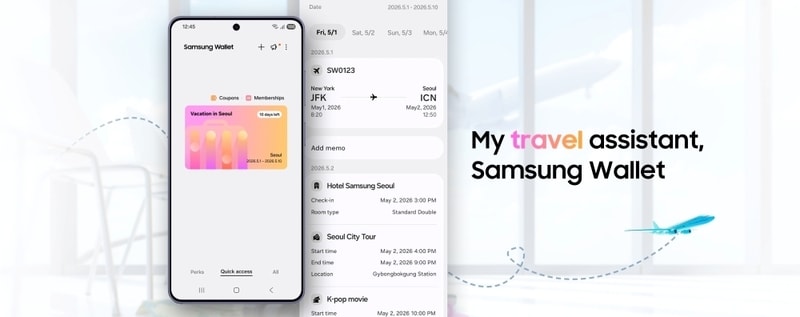
Samsung Wallet’s Trips feature centralizes bookings, tickets, itineraries and notes into a single time-and-location timeline, aiming to improve travel convenience and ecosystem stickiness. The article highlights potential partnerships with airlines and hotels and the ability to generate richer user insights for personalized services. The piece is strategic and product-focused, with limited near-term financial impact.
This is less a standalone product tweak than another data-aggregation wedge in the race to own the pre-trip decision layer. The strategic value is not the itinerary itself; it is the incremental frequency with which a consumer opens the wallet before a flight, hotel check-in, or disruption event, which raises the odds of cross-sell and reduces dependence on third-party travel apps. That improves retention economics for the platform owner even if direct monetization is initially modest.
Second-order winners are ecosystem partners that can monetize intent at the moment it is highest and most explicit: airlines, hotel chains, and travel insurers. The most exposed losers are point solutions in travel organization, email-based booking management, and standalone loyalty apps, because their utility is vulnerable to being subsumed into a default OS-level wallet. Over time, the bigger threat is not wallet competition per se, but the normalization of the OS becoming the travel operating system, which compresses distribution margins for all travel intermediaries.
The near-term catalyst profile is limited; this is a multi-quarter adoption story, not a day-trade. The key risk is engagement fatigue: if users only interact with the feature a few times per year, the data moat may be thinner than the market expects, and the wallet becomes a convenience layer rather than a habit-forming surface. Another reversal risk is privacy friction—travel context is highly sensitive, and any perception of overreach could slow permissioning and reduce the quality of personalization.
The consensus may be underestimating how small usage frequency can still be strategically valuable if it occurs at moments of high commercial intent. The more interesting effect is not wallet share, but downstream conversion lift for partner services and reduced customer acquisition cost for whoever controls the entry point. That argues for viewing this as a structural distribution advantage for platform owners, while being more selective on travel-app pure plays that lack OS-level leverage.
AI-powered research, real-time alerts, and portfolio analytics for institutional investors.
Request DemoOverall Sentiment
mildly positive
Sentiment Score
0.15
