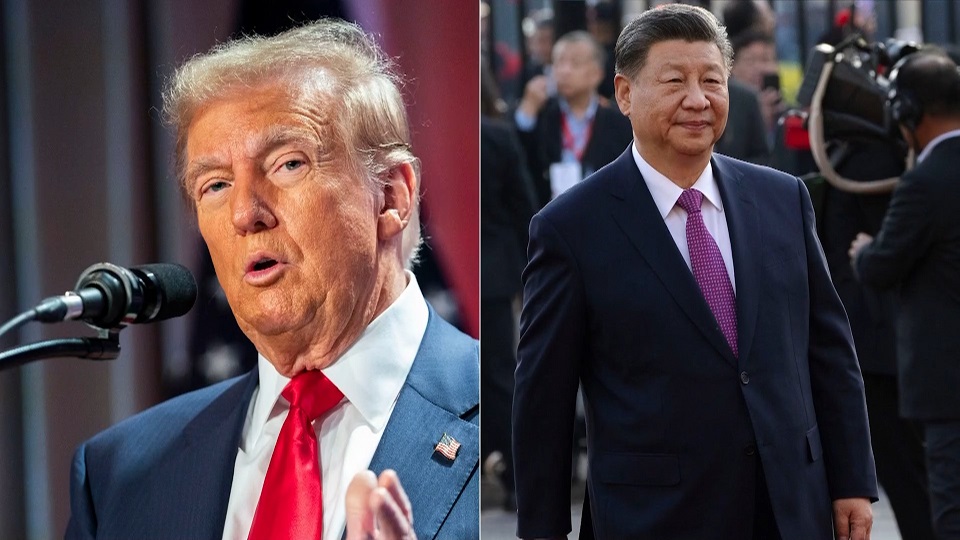
Chinese President Xi Jinping, during a phone call with U.S. President Donald Trump, pressed the U.S. on the status of Taiwan, asserting that Taiwan’s return to Chinese control is a core element of the post-World War II international order. The exchange signals Beijing’s explicit diplomatic pressure on a flashpoint issue that could heighten geopolitical risk and complicate U.S.-China relations, with potential implications for regional security, defense planning and markets sensitive to China-Taiwan tensions.
Market structure will bifurcate: defense and sovereign-risk hedges gain pricing power while Taiwan-dependent consumer tech and regional supply-chain exposed OEMs face demand risk and higher logistics costs. Expect +10–20% relative outperformance for prime defense primes (LMT, NOC, RTX) over SMID tech in a 3–12 month stress window as risk premia reprices and governments accelerate procurement. Commodity importers/exporters will see divergent flows: oil and base metals likely spike 3–8% on Strait disruption scenarios, while container freight rates jump if rerouting persists beyond 2–4 weeks.
Tail risks include a kinetic blockade or cyber shutdown of fabs — low-probability but market-disruptive, potentially cutting ~30–50% of advanced logic capacity temporarily; insurance and sanctions cascades add regulatory risk to multinationals. Immediate (days): volatility and safe-haven flows; short-term (weeks–months): supply-chain rerouting and capex acceleration; long-term (quarters–years): structural decoupling driving onshoring and subsidy-driven winners. Monitor 10yr UST yield moves (<3.5% trigger for crowding into duration) and VIX >25 as tactical entry signals.
Trades: favor long defense (LMT, NOC) and commodity exporters (RIO.L, BHP) while trimming absolute exposure to Taiwan-heavy semiconductors (TSM, SMH) by 3–5% of portfolio. Use options to cost-effectively hedge: buy 3-month SMH 15% OTM puts and/or VIX 1-month calls if VIX remains <20; deploy covered-call overlays on core tech to monetize elevated premiums. Pair trades: long ITA (defense ETF) vs short XLK (tech) sized 50–75bps each to capture relative re-rating over 3–12 months.
Contrarian view: consensus may underprice TSMC’s strategic leverage — if conflict is avoided, TSM could re-rate on pricing power; avoid knee-jerk shorts on TSM below $90 (hypothetical) and instead size shorts to 1–2% with strict stop-losses. Historical parallels (Korean tensions 2010s) show quick de-escalation followed by muted long-term dispersion; therefore keep hedges time-boxed to 60–180 days and watch diplomatic cadence (next US-China high-level contact within 30 days) as a potential unwind catalyst.
AI-powered research, real-time alerts, and portfolio analytics for institutional investors.
Request DemoOverall Sentiment
mildly negative
Sentiment Score
-0.30
