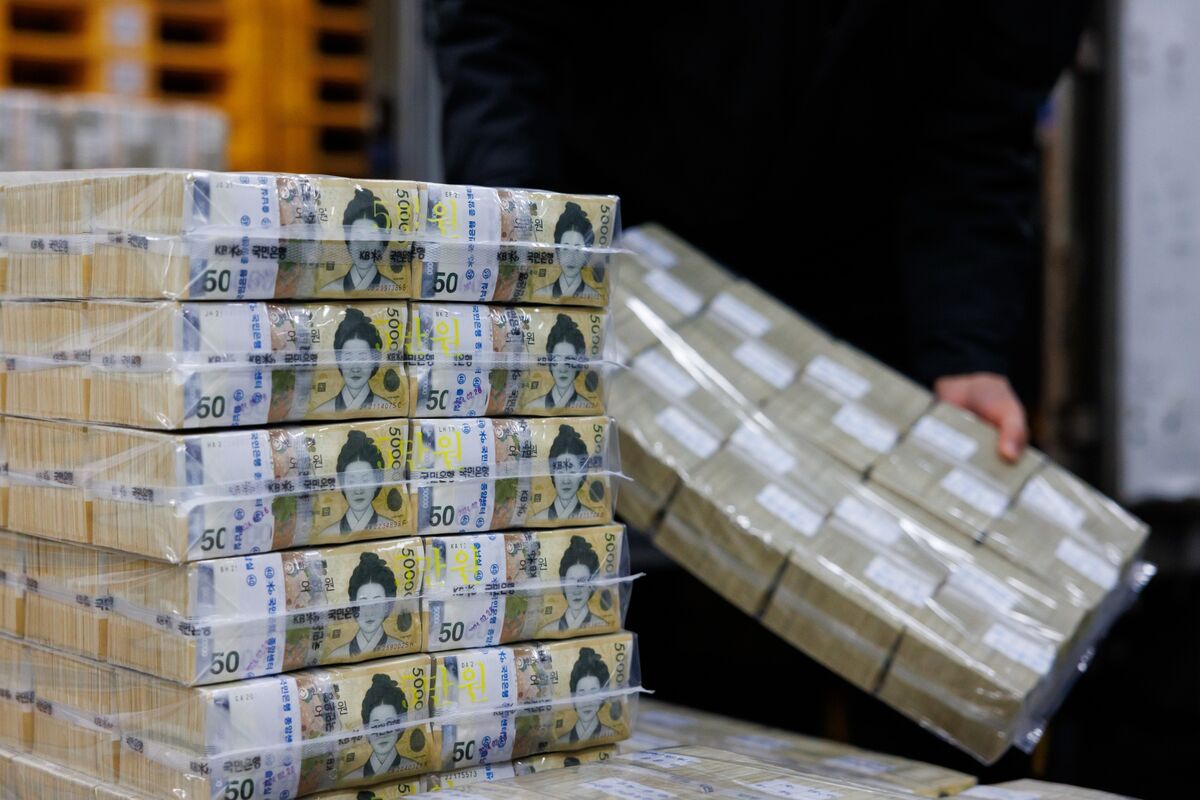
The Korean won slid as much as 0.5% to 1,479 per dollar—its weakest level since April 9—pressured by increased overseas investments from local funds and is tracking for year-to-date losses even as many EM peers have strengthened. The currency is approaching a closely watched dollar‑sale trigger level ahead of the Bank of Korea’s policy decision this week, raising the prospect of central‑bank intervention and making offshore flows and the upcoming rate call key near‑term drivers for FX and EM positioning.
Market structure: A weaker won structurally benefits Korea’s large FX‑earnings exporters (semiconductors, autos) and US‑listed Korean ADR exposure while compressing real returns for local currency bondholders and FX‑short banks. If offshore sales continue, expect steeper KRW forwards and tighter two‑way liquidity, shifting pricing power modestly toward exporter equities and FX forwards dealers that can warehouse risk. Cross‑asset spillovers should lift Korean equities with export bias and push local sovereign yields +10–40bp as FX hedging costs rise; KRW option vol will reprice higher near the central‑bank event.
Risk assessment: Near term (days) the binary BOK policy call and potential FX intervention are dominant tail events; intervention would temporarily tighten KRW liquidity and steepen short‑end rates, while non‑intervention risks a clean continuation to 1,500 USDKRW (high‑impact). Over weeks/months, corporate FX hedging adjustments and offshore fund flows are second‑order drivers that can flip sentiment; hidden dependency: Korean corporates’ USD funding roll‑overs and forward cover ratios amplify moves. Catalysts that could accelerate a move include a surprise BOK verbal cue, US data shifting Fed expectations, or large offshore redemptions (>$1bn/week net).
Trade implications: Tactical long exposure to export champions with natural FX hedges (e.g., Samsung Electronics via SSNLF or 005930.KS) benefits from a weaker won; size 2–3% portfolio with a 3–6 month horizon and FX stop at USDKRW 1,500. Short selective domestic banks (KB Financial 105560.KS, Shinhan 055550.KS) 1–2% to capture NIM and credit spread risk if short‑term rates rise; cover on confirmed BOK intervention. Use USDKRW call spreads (1,490/1,520 1‑month) to express a limited‑risk bet on further depreciation while selling shorter‑dated KRW volatility if vol spikes.
Contrarian angle: The market may be overpricing permanent KRW weakness; past BOK interventions produced mean‑reversion within 4–8 weeks, not multi‑quarter depreciations. If offshore sellers are tactical (quarter‑end rebalancing), a forced squeeze could produce fast recoveries—look for divergence between onshore NDF and onshore spot flows as a signal. Unintended consequence: preemptive FX‑sale intervention could raise local rates and hurt domestic equities more than it helps FX, creating a buying opportunity in export cyclicals on intervention news.
AI-powered research, real-time alerts, and portfolio analytics for institutional investors.
Request DemoOverall Sentiment
moderately negative
Sentiment Score
-0.35
