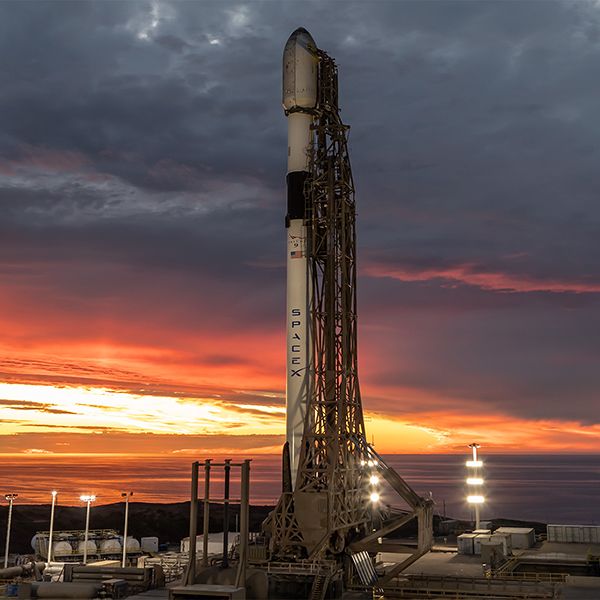
SpaceX’s Falcon 9 successfully launched the Starfall Demo mission to low-Earth orbit from Cape Canaveral on June 23 at 6:53 a.m. ET, with the first stage completing its 29th flight and landing on the A Shortfall of Gravitas droneship. The mission timeline shows a routine launch profile, including Max Q at 00:01:08, stage separation at 00:02:28, and landing at 00:08:49. The article is primarily a technical mission update with limited immediate market impact.
The incremental signal here is not the launch itself but the operating leverage embedded in reusability: a first stage reaching 29 flights implies the economics of marginal launches are still improving faster than most of the public space complex can model. That matters because the gap between “launch as a service” and “launch as infrastructure” keeps widening; the more often the booster is reused, the more SpaceX can undercut smaller launch providers on cadence, not just price. Over the next 6-18 months, that should pressure any late-stage venture-backed launcher that needs a clean sheet of capital expenditure to compete on reliability and turnaround.
The second-order beneficiary is the downstream constellation stack. Higher launch cadence and lower unit cost accelerates deployment for operators that monetize orbit density rather than hardware margins, which favors firms with recurring revenue tied to coverage, latency, or government contracts. The loser set is broader than pure launch rivals: satellite bus manufacturers, ground-network vendors, and defense primes with “launch-adjacent” optionality may see budget share migrate toward direct-to-orbit, vertically integrated architectures.
The key risk is not technical failure on a single mission; it is a competitive response cycle. If reusability continues to compress prices faster than demand expands, the industry can enter a self-defeating margin war where launch prices fall faster than payload demand grows, delaying profitability for everyone except the most vertically integrated player. Over a multi-quarter horizon, that creates a winner-take-most dynamic in which small slips in reliability or turnaround can be punished disproportionately because customers will tolerate almost no premium for legacy cadence.
The contrarian read is that the market still treats launch milestones as binary news instead of a compounding cost curve. The real trade is not “space up or down,” but whether reusable infrastructure adoption is accelerating enough to re-rate the value chain away from high-capex launch providers and toward software-like satellite connectivity and defense-enabled data layers. That shift is probably underappreciated because it unfolds quietly over quarters, while the headline event is over in minutes.
AI-powered research, real-time alerts, and portfolio analytics for institutional investors.
Request DemoOverall Sentiment
neutral
Sentiment Score
0.10
