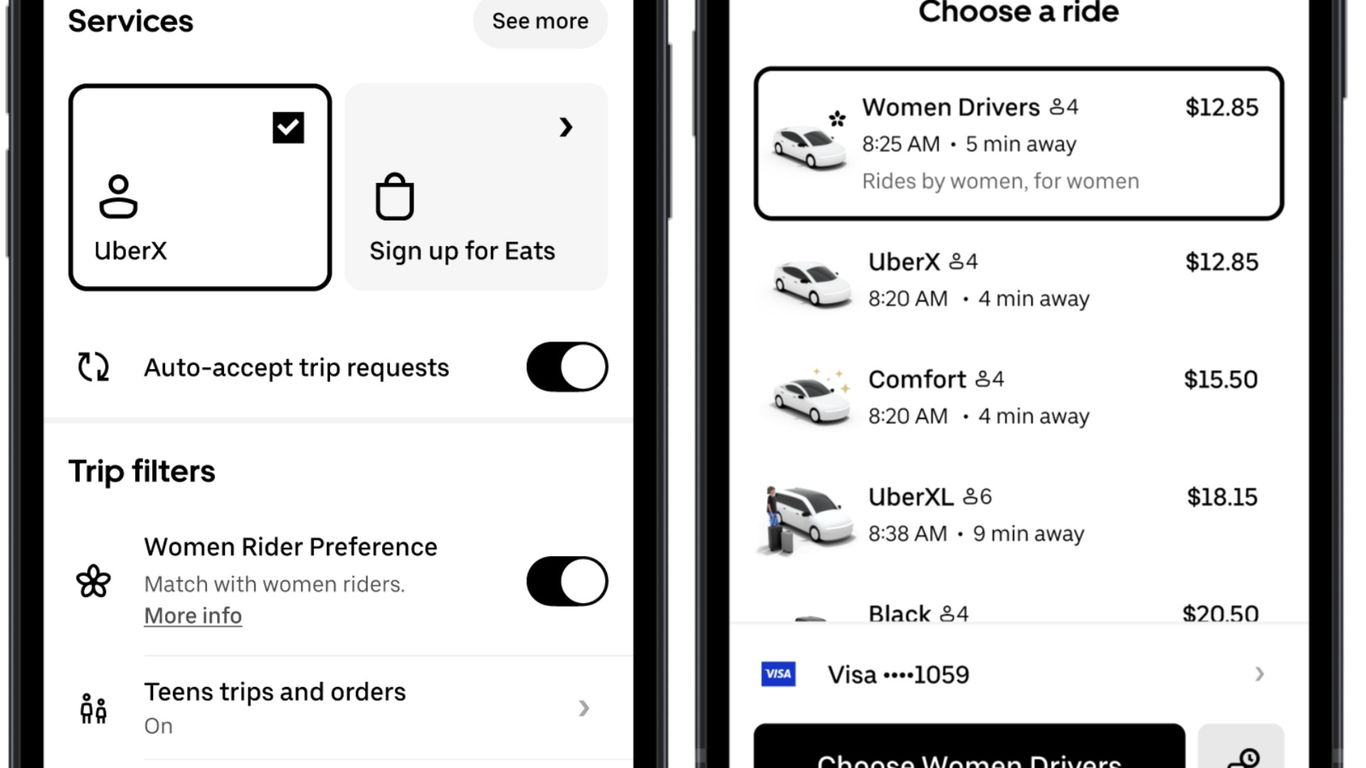
Uber is rolling out its 'Women Preferences' nationwide starting Monday; the feature has powered more than 230 million trips globally and is available in 40+ countries. Women riders can request or reserve woman drivers and women drivers can opt to receive trips only from women, but women make up roughly 1 in 5 U.S. drivers, creating a supply constraint and uneven availability. Pilot wait times were said to be similar to UberX but Uber provided no detailed metrics or evidence of improved female driver recruitment/retention. A class-action suit by male drivers in California alleges discrimination, introducing legal risk as the feature scales.
This feature is a deliberate product-level attempt to convert safety preferences into engagement and retention advantages for a targeted rider cohort; the economic payoff depends on whether supply (drivers opting in) can scale without creating material friction elsewhere on the marketplace. Expect pronounced heterogeneity across metros — in tight supply markets any opt-in routing will either raise wait times for non-preferred pairings or force the platform to pay to reallocate drivers, transferring the cost to unit economics.
A litigation/regulatory path is the principal tail risk and has asymmetric timing — administrative actions or class litigation can take quarters to resolve but can force sudden business-model changes in a single jurisdiction, creating episodic volume or margin shocks. Equally important is precedent risk: a ruling that limits gender-based matching would quickly narrow product differentiation industry-wide and revive a feature arms race toward other non-protected personalization layers.
Second-order competitive effects favor the larger marketplace operator that can tolerate short-term matching inefficiencies by cross-subsidizing with other high-frequency trips; smaller competitors with thinner liquidity will suffer more volatile rider experience, amplifying churn. Recruiting economics will matter: to hit meaningful supply improvements the platform will likely need targeted incentives that raise CAC per driver and temporarily depress contribution margins, but this could convert to a durable loyalty moat if conversion/retention metrics move materially.
Monitor three near-term readouts as decision triggers: female-driver participation growth (supply elasticity), differential wait-time and pricing dispersion versus baseline, and legal/regulatory docket events. These will determine whether the move is a low-cost product wedge that scales or an expensive customer-acquisition program with legal overhang that compresses FCF.
AI-powered research, real-time alerts, and portfolio analytics for institutional investors.
Request DemoOverall Sentiment
mixed
Sentiment Score
0.00
Ticker Sentiment
