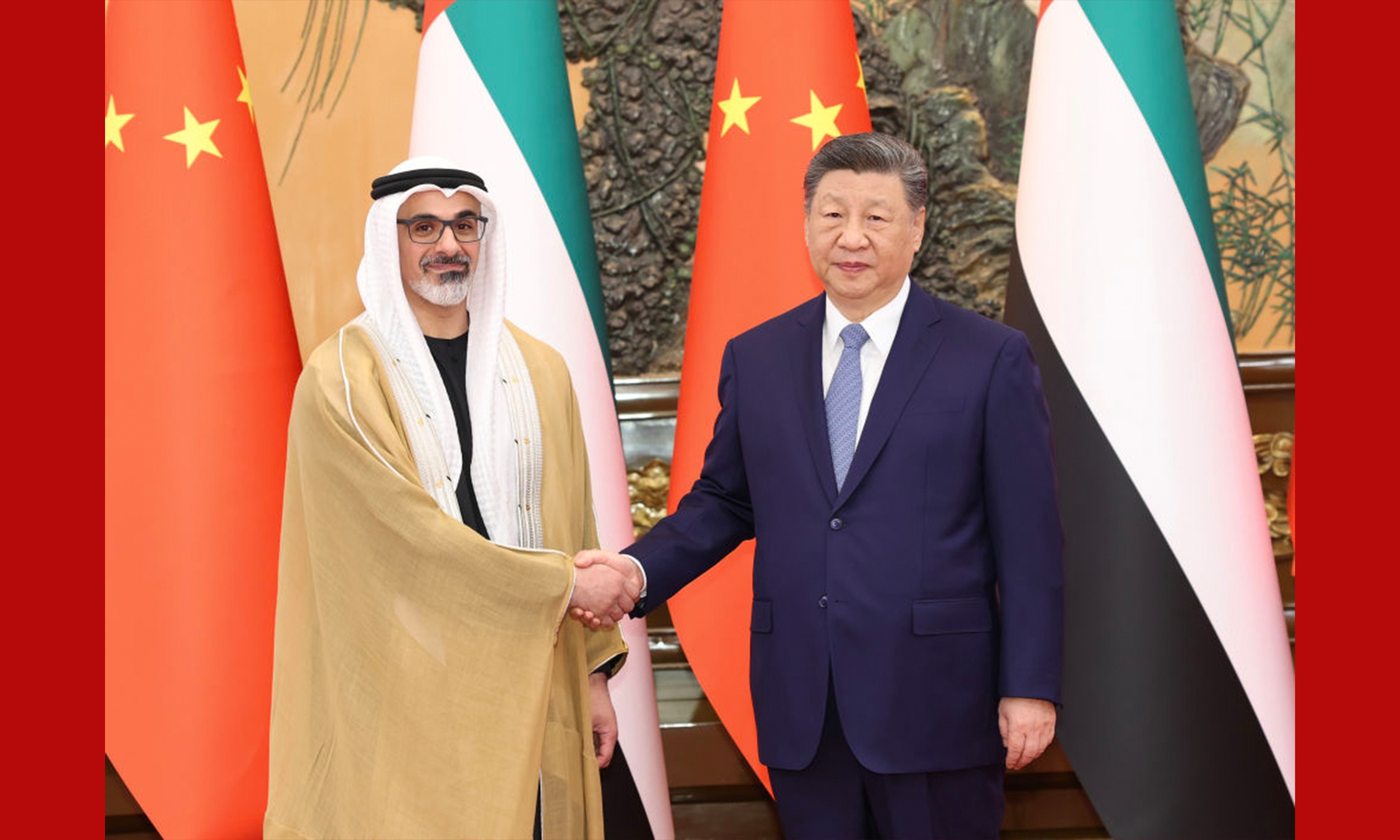
Xi Jinping met UAE Crown Prince Sheikh Khaled bin Mohamed bin Zayed Al Nahyan in Beijing to reaffirm the China-UAE comprehensive strategic partnership and deepen cooperation in energy, investment, trade, technology, education, civil aviation and tourism. Both sides emphasized stronger coordination on Middle East and Gulf stability, including ceasefire efforts, protection of shipping security, and limiting spillovers to the global economy and energy security. The article is largely diplomatic and incremental, with limited immediate market impact.
This is less about a near-term bilateral breakthrough and more about China signaling it wants Gulf energy flows, capital, and shipping security wrapped into a broader strategic umbrella. The UAE sits at the intersection of three scarce assets China cares about: reliable hydrocarbons, a logistics hub for re-routing trade, and one of the few Middle East partners comfortable balancing Washington, Beijing, and regional de-escalation. That makes the UAE a useful proxy for how China intends to insulate itself from maritime disruption and from any future tightening of Western enforcement around sanctioned energy and dual-use trade.
The second-order trade implication is that the highest-beta beneficiaries are not Chinese equities but Gulf infrastructure, ports, shipping services, and state-linked energy capex. If this relationship deepens, expect more transshipment, warehouse, and industrial-zone activity in the UAE as Chinese firms use it as a staging ground for MENA and Africa, which supports demand for freight, port throughput, and construction materials over 6-18 months. The losers are firms relying on a clean bifurcation between East and West supply chains; the UAE becomes an even more important arbitrage node, which compresses margins for intermediaries that cannot clear sanctions, origin, or financing complexity.
The biggest risk is that markets overrate diplomacy and underprice operational fragility: any Gulf shipping incident or US pressure on technology transfer could quickly slow the pace of cooperation even if headline language stays positive. Conversely, a meaningful de-escalation in the region would likely support lower risk premia in energy and freight, but that effect is more gradual than the headline suggests. The near-term catalyst set is thin; this reads as a strategic positioning move, not an immediate earnings event.
Contrarian view: consensus may be too focused on oil supply security and not enough on China using the UAE as a financial and logistics workaround for trade frictions. If that interpretation is right, the best expression is not a directional oil trade but a relative-value basket on UAE-linked infrastructure, ports, and industrial real estate versus broader emerging markets. The market likely underprices the persistence of these flows because they are incremental, non-transparent, and can scale without needing a formal policy announcement.
AI-powered research, real-time alerts, and portfolio analytics for institutional investors.
Request TrialOverall Sentiment
neutral
Sentiment Score
0.05
