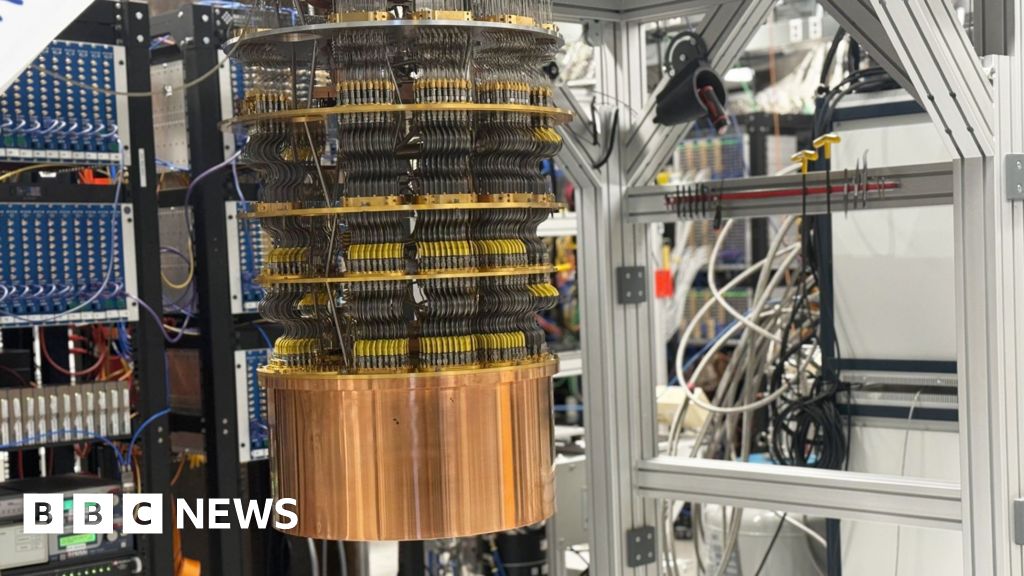
Google's Willow quantum chip, a 105‑qubit superconducting device, reportedly executed a benchmark problem in minutes that would take the best classical computer roughly 10 septillion years and demonstrated repeated‑round error correction—a key step toward scalable, utility‑scale quantum processors. If scaled to million‑qubit, error‑corrected machines within the coming decade, applications could materially accelerate drug discovery, materials science and energy systems while simultaneously threatening current encryption and cryptocurrency security ('Harvest Now, Decrypt Later'). The breakthrough sharpens the global race—China has committed about $15bn to quantum programs and the UK plans major funding—creating strategic export‑control, supply‑chain and defense implications for investors in AI chips, semiconductors, cybersecurity and crypto‑exposed assets.
Winners & losers: Google (GOOGL/GOOG) emerges as the primary beneficiary from Willow’s error-correction and benchmark claims — a 12–36 month runway exists for commercial cloud/AI premium expansion as Google bundles quantum IP with vertex AI services. Nvidia (NVDA) retains strategic relevance as classical-quantum hybrid systems will still need GPUs; expect modest upside (1–3% incremental TAM uplift over 2 years) rather than displacement. Chinese internet names (BIDU, BABA) face structural downside from Beijing’s centralisation of quantum R&D and increased export-control friction, compressing optionality and raising regulatory beta.
Risk assessment: Tail risks include near-term export-control escalation (US/EU/UK sanctions within 90 days) and “harvest now, decrypt later” state actions that could force immediate security spend and accelerated blockchain forks by 2028. Hidden dependencies: helium/cryogenics, superconducting-wafer supply, and top-tier talent concentration — single-point failures that can delay scaling by 12–48 months. Catalysts that accelerate adoption are successful error-correction rounds and a commercial win (drug design proof) within 18 months; reversals include reproducibility failures or funding pullbacks.
Trade implications: Prefer concentrated, time-boxed positions: core long GOOG (2–3% NAV) with 12–36 month LEAP call spreads to cap cost; add tactical NVDA call spreads (1% NAV) to play GPU+quant overlap. Pair trade: long GOOG / short BABA or BIDU (1:1 notional, 1–2% NAV each) over 6–24 months. Hedge crypto: buy multi-year BTC downside protection (2-year puts ~50% OTM sized to cover 50% of crypto exposure) and increase allocation to quantum-resistant crypto projects.
Contrarian angles: The market underestimates implementation friction — scaling to utility-scale 1M qubits likely >5 years if supply-chain/talent or error-correction costs spike, so valuations priced for imminent monetisation are overdone. Conversely, defence/telecom suppliers and Western cloud providers could see outsized near-term revenue as governments accelerate procurement — an underowned trade today.
AI-powered research, real-time alerts, and portfolio analytics for institutional investors.
Request DemoOverall Sentiment
mildly positive
Sentiment Score
0.28
Ticker Sentiment
