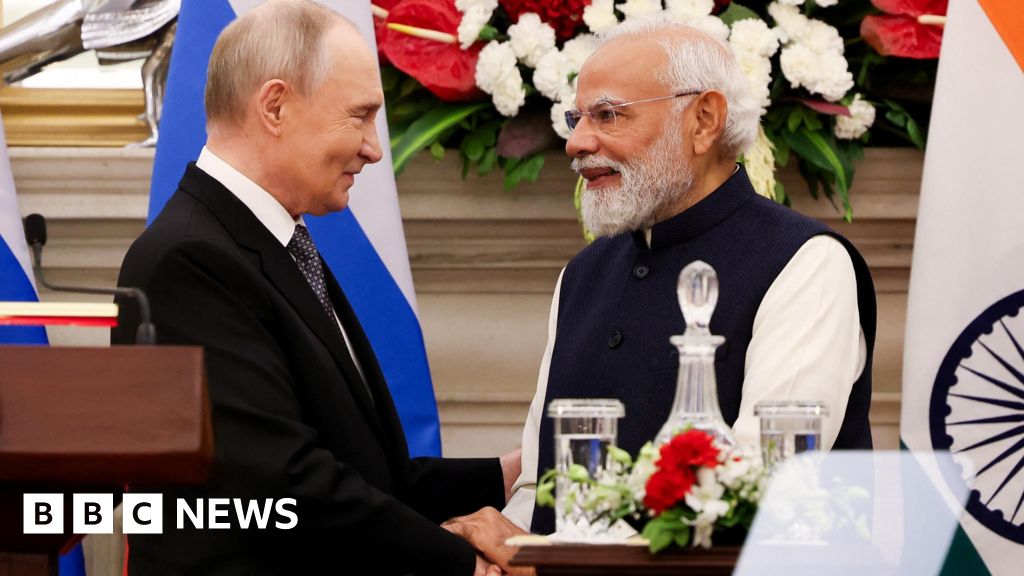
Russian President Vladimir Putin pledged 'uninterrupted shipments' of fuel to India as the two leaders signed memoranda on trade, shipbuilding, civil nuclear energy, critical minerals and a bilateral economic programme aimed at raising trade from $60bn toward $100bn. The meeting comes amid U.S. tariffs on Indian goods tied to Delhi's purchases of Russian oil and ongoing geopolitical risk from the Ukraine war, while India announced visa relaxations, new consulates and cooperation on a flagship nuclear power project — developments that could reorient energy and commodity flows but increase geopolitical and sanction-related uncertainty for investors.
Market structure: India acting as a durable buyer of discounted Russian crude re-routes seaborne flows and directly benefits Russian producers, large Indian refiners (e.g., Reliance), and freight owners; exporters to the US-facing tariff risk (goods) are losers. Expect Russia to capture incremental market share equal to a few hundred kb/d to India over 6–24 months, with bilateral trade target moving from $60bn → $100bn as stated, supporting refinery throughput but pressuring global net importers.
Risk assessment: Biggest tail risks are rapid US escalation to secondary sanctions on buyers (days–weeks) or a Ukraine escalation that removes Russian barrels (weeks–months), each capable of ±$20–30/bbl moves in Brent. Hidden dependencies include payment/settlement mechanics (rupee/ruRuble corridors), insurance/freight re-routing costs and ability of refiners to process Urals-quality crude; catalysts are OPEC+ meetings, US Treasury/OFAC guidance, and India import volumes reported monthly.
Trade implications: On balance, favor energy/refining exposure in India and selective Russian energy exposure while keeping tight sanction stops; expect INR and Indian sovereign spreads to be sensitive to US tariff headlines so use FX/bond hedges for export-exposed portfolios. Commodities: Brent upside is capped by flows to India absent sanction shocks, but volatility spikes on geopolitical headlines argue for option-based plays rather than outright directional futures positions.
Contrarian angle: Consensus assumes sanctions will choke Russian barrels — that’s underestimating buyers (India/China) and logistics workarounds; if bilateral normalization proceeds, Russian energy assets and Indian refiners will outperform for 3–12 months. Conversely, if markets overprice immediate sanction risk, short-dated volatility will be rich; targeting calendar spreads and disciplined stop-losses captures that mispricing.
AI-powered research, real-time alerts, and portfolio analytics for institutional investors.
Request DemoOverall Sentiment
neutral
Sentiment Score
0.10
