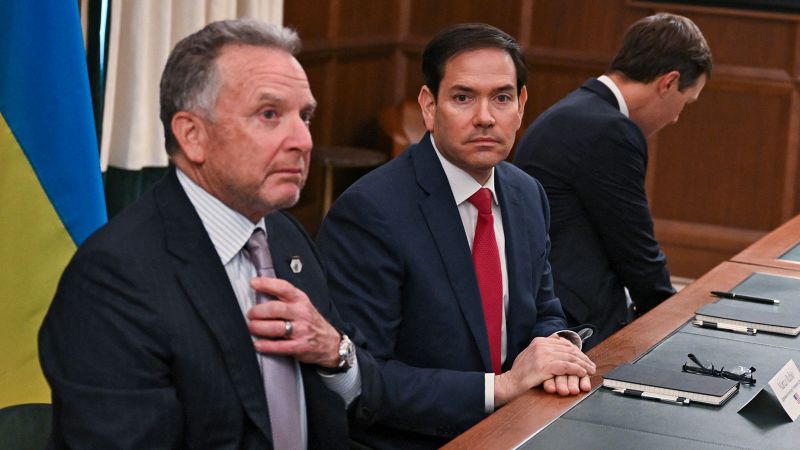
Senior US and Ukrainian delegations held intensive, reportedly constructive talks in Florida involving Secretary of State Marco Rubio, envoy Steve Witkoff and Jared Kushner, building on earlier Geneva discussions over a 28-point US peace proposal for the Russia-Ukraine war. Key sticking points include Moscow's demand that Ukraine forswear NATO membership and relinquish control of parts of the Donbas; negotiators are exploring work-arounds (including bilateral or NATO-Russia arrangements) that would avoid forcing Ukraine to amend its constitution, but no final decisions have been made and Kremlin acceptance remains uncertain.
Market structure: A credible US-brokered de-escalation that limits Ukraine’s NATO route would be a shock absorber for energy and risk premia — I estimate a 8–20% reduction in a war-risk premium on Brent over 1–3 months versus current levels if negotiations visibly progress. Winners: European cyclical sectors (autos, travel, banks) and front-line reconstruction/materials exposure; losers: short-dated defence cyclicality (a 5–15% downside re-rate for pure-play defence contractors within 3 months if conflict risk falls). FX and rates: lower risk premia should pressure USD (~2–4% weaker vs EUR in 1–3 months) and push 10y UST yields down 15–35bps (TLT +3–6%).
Risk assessment: Tail-upside for prices arises from a Kremlin rejection or a political backlash in Kyiv/Brussels — a breakdown could spike Brent +30–60% and lift defence equities +20–50% within weeks. Time horizons: immediate (days) volatility around leaks/words), short-term (weeks–months) pricing of ceasefire probability, long-term (quarters–years) structural shifts (NATO politics, sanctions permanence). Hidden dependencies include unanimity requirements inside NATO and timelines for sanctions relief; both can reverse market moves abruptly. Key catalysts: formal NATO language, Kremlin sign-off, Zelensky/Rada votes, and OPEC+ reactions — watch these 30–90 day windows.
Trade implications: Tactical short of aerospace & defence beta and tactical long of European cyclicals and duration are highest-conviction plays; options allow skew capture for asymmetric outcomes. Position sizing should be binary: 1–3% portfolio-sized event trades with stop-losses and time-decay control (3-month horizons). Use ETF vehicles for speed (ITA short, VGK long, TLT long) and choose 3-month option structures to express conviction with defined risk.
Contrarian angles: Consensus assumes a linear peace = lower defence forever; that misses medium-term political backlash that could force renewed NATO spending within 6–24 months — i.e., defence may trough then re-accelerate. Markets may underprice a two-stage outcome: near-term risk-on (commodities down, equities up) followed by persistent elevated base defence budgets; that creates a window to fade defense weakness and buy value in 12–24 months.
AI-powered research, real-time alerts, and portfolio analytics for institutional investors.
Request DemoOverall Sentiment
neutral
Sentiment Score
-0.10
