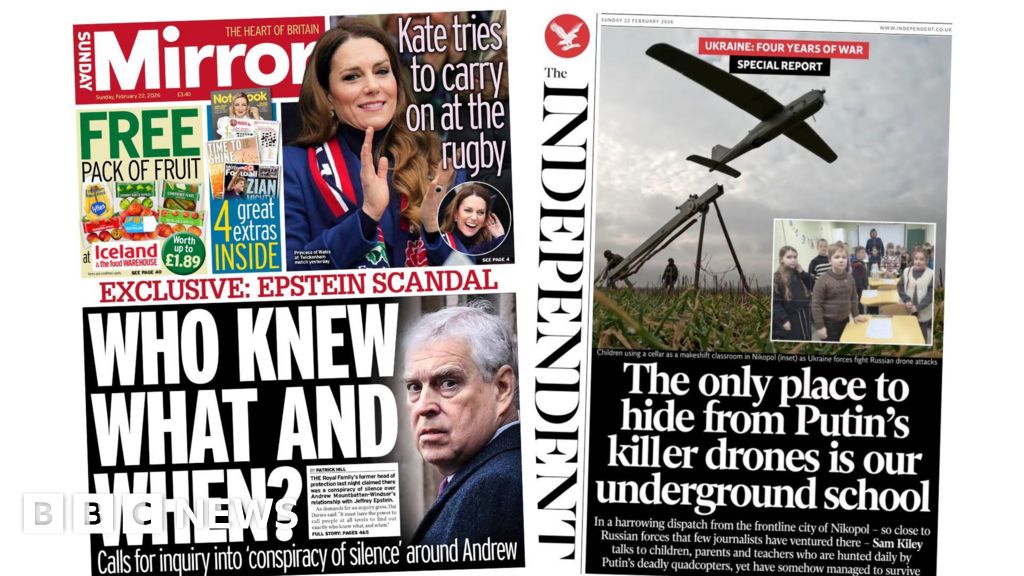
UK papers report escalating political and reputational risk: police are investigating Prince Andrew over alleged links to Jeffrey Epstein with Buckingham Palace authorising access to files, while former PM Gordon Brown has called for further inquiries. Internationally, President Trump said he would raise a global tariff from 10% to 15%, prompting concern from UK exporters and raising trade/tariff risk; concurrently the shadow foreign secretary is in Washington pressing on the Chagos sovereignty issue, and Defence Secretary John Healey has urged an end to the Russia-Ukraine war by 2026. These developments increase political and geopolitical uncertainty rather than immediate market-moving financials, but represent modest downside risks to exporters and sectors sensitive to reputational or sovereign-policy shifts.
Market structure: A permanent move from a 10% to 15% global tariff is an immediate ~5 percentage-point shock to cross-border price transmission — expect import-intensive UK exporters and European supply-chain exposed small caps to see 1–4% EBITDA pressure in the next 1–3 quarters while US domestic producers enjoy pricing power. Sterling should trade weaker versus USD/EUR on elevated UK political/legal risk and export margin fear, creating FX-driven earnings beats for USD-reporting multinationals and headwinds for GBP-denominated assets.
Risk assessment: Tail risks include a full-scale US-EU trade escalation (low prob, high impact) that could lift core inflation by 50–150bps cumulatively over 12 months and push Treasury yields 10–30bps higher near term; Ukraine escalation is an independent tail raising defense/energy risk premia 5–15% in 1–6 months. Hidden dependencies: corporate long-term supply contracts, hedging programs, and invoicing currency mean headline tariff moves will phase into P&L unevenly over 3–12 months.
Trade implications: Expect sector rotation into US domestic cyclicals and defense (6–18 month horizon) and a volatility pick-up in exporter equities and GBP options; commodities (oil/wheat/metals) carry a 5–15% upside skew if geopolitical risk rises. Bonds should see safe-haven flows but also inflation repricing—position durations cautiously, favoring 2–7yr over 10+yr if yields rise 10–25bps.
Contrarian angles: Consensus assumes tariffs permanently crush global trade flows; history (2018–19 tariffs) shows corporate pass-through, sourcing shifts and policy reversals can halve the initial impact within 6–12 months. Mispricings likely in hedged UK exporters and defense suppliers with stable orderbooks where downside is priced as if tariffs are permanent; if formal tariff implementation is delayed >30 days or scaled back, mean reversion trade is plausible within 3 months.
AI-powered research, real-time alerts, and portfolio analytics for institutional investors.
Request DemoOverall Sentiment
mildly negative
Sentiment Score
-0.30
