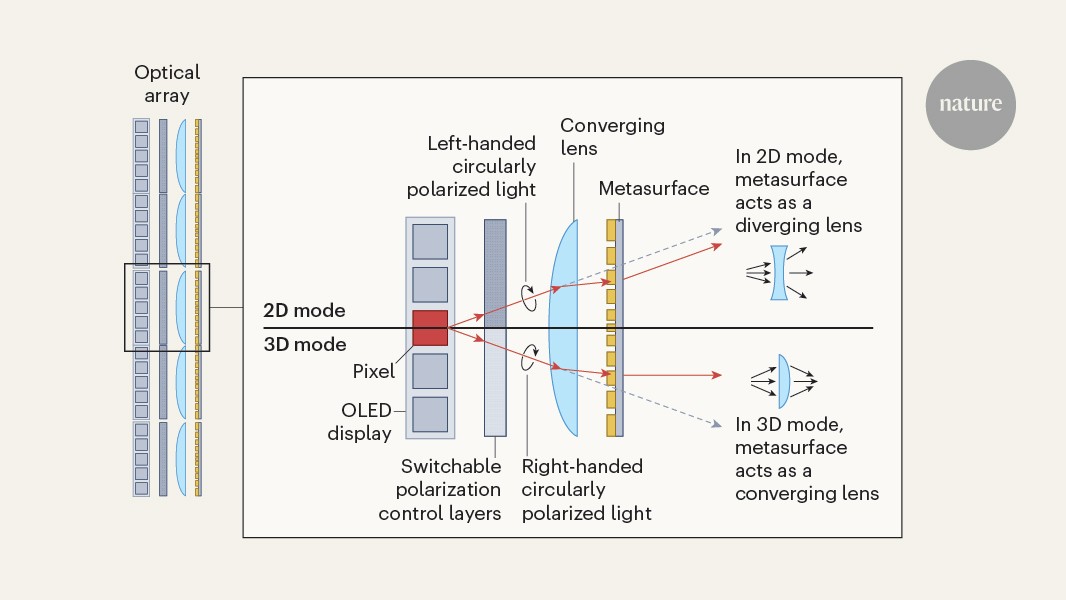
The article describes a glasses-free display that can switch between 2D and 3D viewing modes, highlighting a consumer display technology advance. No financial figures, company guidance, or market-moving commercial details are provided. The piece is primarily scientific and technical in nature, with limited direct near-term market impact.
This is not a demand story; it is a substitution story. The commercial prize is not the display itself but the enabling stack: optics, microdisplay backplanes, eye-tracking/gesture sensing, and the software layer that decides when 2D or 3D is valuable enough to justify a premium. If the technology moves from demo to SKU, the first beneficiaries are likely component suppliers with exposure to compact optics and specialized panels, while the biggest pressure lands on incumbents whose differentiation depends on 2D-only screens and commoditized hardware margins.
The second-order effect is that glasses-free 3D is most likely to win in narrow, high-ARPU use cases before it becomes a mass consumer feature. That means enterprise visualization, medical imaging, industrial design, and premium gaming are the real near-term addressable markets; consumer laptops/phones are a longer-duration option, not a near-term volume driver. Supply chain winners will be vendors that can integrate optical layers and low-latency compute without meaningfully increasing BOM or power draw; if those frictions remain high, adoption will stall after early enthusiasm.
The main risk is that this becomes a feature, not a category, with no pricing power. If OEMs can market “2D/3D switchable” but can’t raise ASPs by at least mid-single digits, the tech may add complexity faster than it creates profit, especially if yield losses or calibration costs remain high. The market will likely overestimate the speed of consumer adoption and underestimate how long content creation/tooling must catch up—measured in quarters for enterprise pilots, but years for broad platform penetration.
The contrarian view is that the most attractive value may sit downstream in software and content workflows, not hardware. Whoever controls 3D asset generation, conversion, and display optimization could capture a recurring revenue stream even if the hardware becomes commoditized. That creates a classic picks-and-shovels setup: own the layer that makes the novelty usable, not the panel maker that makes the novelty visible.
AI-powered research, real-time alerts, and portfolio analytics for institutional investors.
Request DemoOverall Sentiment
neutral
Sentiment Score
0.10
