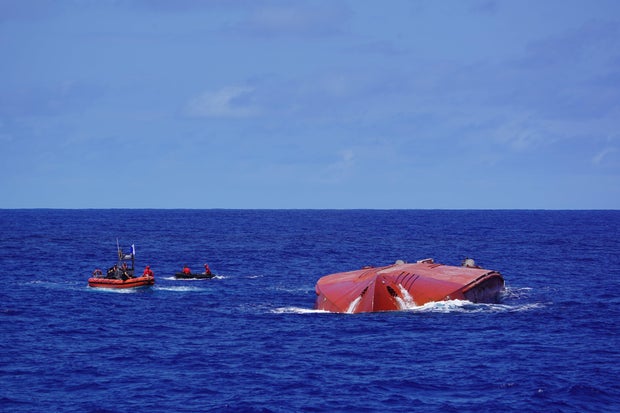
Search efforts for five missing crew members aboard the U.S.-flagged cargo ship Mariana have been suspended after more than 100 hours, following the vessel’s overturning during Super Typhoon Sinlaku. One crew member’s body was recovered April 21, and the ship was last seen about 40 miles northeast of Pagan in the Northern Mariana Islands. The incident underscores severe weather disruption and maritime safety risks, but is unlikely to have broad market impact.
The immediate market impact is less about one vessel and more about the fragility of Pacific logistics under extreme weather. Any operator with exposure to inter-island shipping, port throughput, or time-sensitive regional supply chains should be assumed to face elevated delay costs for the next several weeks, because recovery efforts, debris clearance, and inspections typically create a longer tail than the storm itself. The bigger second-order effect is on insurance and financing: loss severity in a U.S. territory raises the probability of tighter marine underwriting standards and higher premiums across similar routes, which can feed through to transport costs with a 1-2 quarter lag.
From a competitive-dynamics standpoint, larger and better-capitalized carriers may actually gain share if smaller regional operators are forced to idle assets for repairs or lose customer confidence. That creates a relative long opportunity in diversified logistics names versus niche maritime operators with concentrated island exposure. Infrastructure and defense contractors may also see incremental demand over time if policymakers push for hardening of ports, communications, and emergency response assets in the Pacific, but that is a budget-cycle story rather than an immediate catalyst.
The contrarian angle is that the market may overestimate the persistence of disruption if it extrapolates this event into a broad transportation shock. For most global shipping and industrial supply chains, the blast radius is narrow; the real alpha is in insurers, regional transport, and disaster-recovery spend, not in the broader freight complex. The key catalyst window is the next 2-8 weeks: if salvage operations remain extended or additional storm damage emerges, expect a step-up in risk premia; if port activity normalizes quickly, the trade will fade fast.
AI-powered research, real-time alerts, and portfolio analytics for institutional investors.
Request DemoOverall Sentiment
strongly negative
Sentiment Score
-0.75
