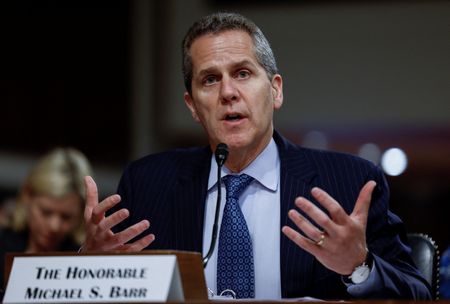
Fed Governor Michael Barr warned that stress in private credit could trigger psychological contagion and a broader credit crunch, with spillover risks extending to banks and insurers. He said direct bank links are not yet alarming, but investor pullback amid valuation and lending-standard concerns could tighten financial conditions. The comments reinforce a cautious Fed stance on private credit, a sector already under pressure from recent market declines and bankruptcies.
This is not a direct NVDA earnings story; it is a funding-risk story that can leak into the physical AI capex stack with a lag. The immediate market read-through is that higher perceived credit stress raises the hurdle rate for every compute buildout tied to venture, private equity, and project finance, which matters most for second-tier OEMs, rack integrators, and downstream buyers with weaker balance sheets. In other words, the policy signal is mildly negative for the breadth of the AI supply chain even if the largest hyperscalers can self-fund through it.
The second-order effect is likely a barbell: top-tier AI capex names stay resilient, while the marginal suppliers that depend on aggressive inventory financing or customer prepayments become more vulnerable over the next 1-3 quarters. If credit spreads widen materially, you tend to see order timing slip before outright cancellations, which hurts semicap equipment, connector, power, and thermal-management vendors first. That means the risk is less about NVDA demand disappearing and more about mix deterioration and slower conversion in the ecosystem around it.
The contrarian view is that this kind of warning often matters most when it is least actionable: if the Fed is talking publicly, markets may already be pricing a decent amount of private-credit stress. Unless we see a real impairment event, the larger beneficiaries are the strongest balance-sheet winners in AI, because tighter credit can actually reinforce share gains toward the best-capitalized platforms. So the setup favors relative value over directional panic.
Near term, watch for any spread moves in private credit, BDCs, and leveraged loan ETFs; a 50-100 bps widening would be the first real confirmation that the issue is propagating beyond headlines. If that happens, the trade is to fade the weakest financing-dependent AI names rather than short NVDA outright. If credit stabilizes, this becomes a one- to two-week noise event with little fundamental follow-through.
AI-powered research, real-time alerts, and portfolio analytics for institutional investors.
Request DemoOverall Sentiment
moderately negative
Sentiment Score
-0.35
Ticker Sentiment
