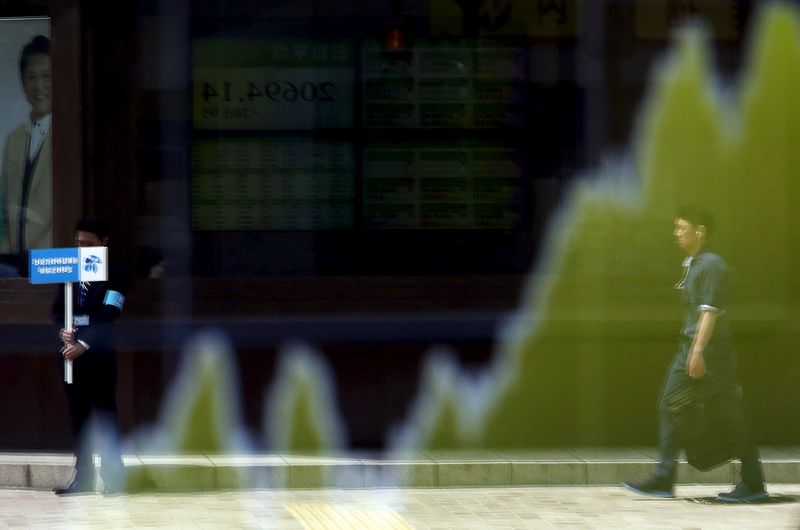
Most Asian stocks gained on Monday, buoyed by soft U.S. payrolls data that increased expectations for a September Fed rate cut. Japan's Nikkei 225 notably surged 1.5% on stronger-than-expected Q2 GDP growth and diminished Bank of Japan rate hike prospects, even as Prime Minister Shigeru Ishiba's unexpected resignation introduced political uncertainty. Broader Asian markets, however, saw more limited gains due to lingering caution over a cooling U.S. economy, with investor focus now shifting to upcoming U.S. consumer inflation and Chinese trade data.
Asian equity markets exhibited a divergent performance, primarily driven by shifting expectations for U.S. monetary policy. Soft U.S. nonfarm payrolls data has solidified market bets for a Federal Reserve interest rate cut of at least 25 basis points in September, lifting S&P 500 futures by 0.2%. However, this optimism is tempered by underlying concerns that the same data points to a slowing U.S. economy. Japan was the clear outperformer, with the Nikkei 225 and TOPIX indices rising 1.5% and 1.1% respectively, approaching recent record highs. This surge was fueled by a significant upward revision to second-quarter GDP growth, attributed to strong exports and private spending, as well as receding expectations for further Bank of Japan rate hikes. The rally occurred despite heightened political uncertainty following Prime Minister Shigeru Ishiba's unexpected resignation, which opens the door to a leadership contest where potential successors are viewed as less fiscally conservative. In contrast, broader Asian markets were more subdued; China's CSI 300 fell 0.2% on profit-taking, while Australian markets lagged as investors rotated out of cyclicals like miners and financials. Specific regional headwinds are also in focus, particularly the threat of 50% U.S. trade tariffs on India, which weighed on Nifty 50 futures.
AI-powered research, real-time alerts, and portfolio analytics for institutional investors.
Overall Sentiment
mixed
Sentiment Score
0.10
Ticker Sentiment
