
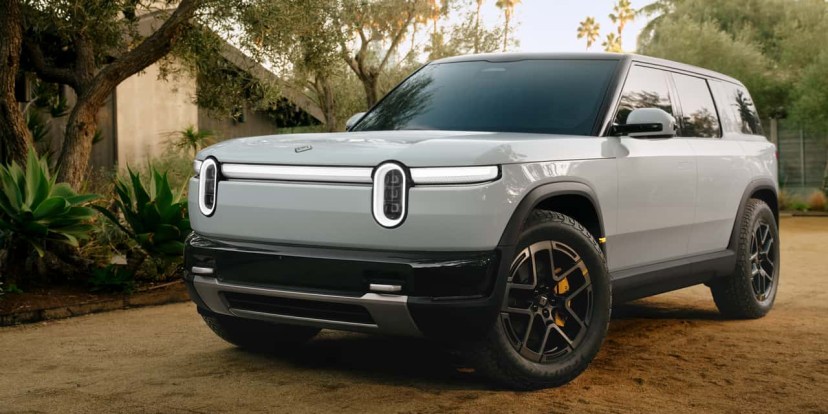
Rivian's new R2 Performance matches Tesla Model Y Performance at 105 MPGe and 32 kWh per 100 miles while offering a longer 330-mile EPA range versus 306 miles for Tesla. The R2 starts at $57,990, with deliveries set to begin June 9, and Rivian also highlighted a lower 99 MPGe variant on 20-inch all-terrain tires. The comparison is constructive for Rivian's product competitiveness, though pricing and scale remain roughly in line with Tesla's established benchmark.
Rivian closing the efficiency gap with Tesla on a conventional SUV shape is more important than the headline comparison suggests: it validates that Rivian’s new architecture can compress the historical penalty for weight and drag, which should improve the market’s willingness to underwrite the R2 as a scalable platform rather than a one-off halo product. The second-order implication is that product appeal and range are no longer the gating variable for mass-market EV adoption in this segment; execution, production cadence, and service footprint become the real differentiators. That shifts the competitive battleground from engineering credibility to operational credibility.
For TSLA, the issue is less immediate share loss than margin defense. A credible, similarly priced rival with comparable range narrows the premium Tesla has enjoyed for being the default efficient EV choice, which can force a higher mix of incentives or financing support over the next 2-4 quarters if R2 supply is adequate. The market may be underestimating how quickly this could pressure Tesla’s performance trim economics in the U.S. crossover category, especially if Rivian’s launch creates incremental conquest from EV intenders rather than just internal brand substitution.
The biggest near-term catalyst/risk is not demand, but production. If Rivian’s June launch is clean and initial customer feedback is strong, the stock can re-rate on the narrative of technical parity; if early builds slip or quality issues emerge, this becomes a “proof-of-concept without scale” story and the multiple should compress. Conversely, if Rivian can sustain even a low-20k unit annual run rate with intact margins, the signal to the broader EV complex is that design-driven differentiation can coexist with efficiency parity, which is constructive for other premium EV launches and slightly negative for incumbent pricing power.
Consensus is likely too focused on the engineering comparison and not enough on channel strategy. Tesla’s real moat here is not range anymore; it is service density, brand habituation, and the ability to weaponize price quickly. The market may also be overestimating how much a strong Rivian launch matters to TSLA near term: unless Rivian scales beyond a niche volume base, this is more a valuation multiple ceiling than a direct earnings shock.
AI-powered research, real-time alerts, and portfolio analytics for institutional investors.
Request TrialOverall Sentiment
mildly positive
Sentiment Score
0.48
Ticker Sentiment
