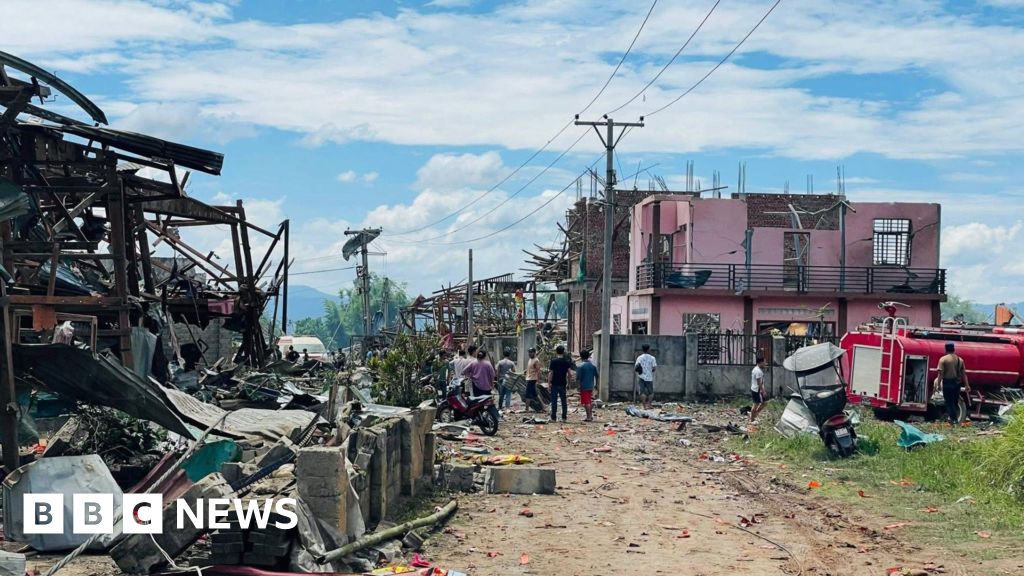
At least 55 people were killed and dozens more wounded in an explosion in rebel-held Kaung Tat village in Myanmar's Shan State, with reports also indicating extensive home damage and children among the dead. The TNLA said mining explosives accidentally detonated around 12:00 local time, though residents initially feared an air strike. The event underscores continuing conflict risk in Myanmar and the hazards tied to mining operations in insurgent-controlled areas.
This is a localized shock, not an immediate macro regime change, but it matters because it lands in a border region where mineral extraction, cross-border logistics, and armed-group financing overlap. The first-order effect is humanitarian; the second-order effect is tighter informal controls on quarrying/mining inputs, which can temporarily disrupt stone, aggregates, rare-earth-adjacent logistics, and cash flows for local armed actors. In a conflict economy, any perceived lapse in explosives management can force a visible enforcement response, which usually means weeks of shutdowns, inspection theater, and higher friction for legal and quasi-legal commodity flows.
The market implication is less about direct equity exposure and more about regional risk premia. If the incident is framed as an accidental industrial blast, headline risk should fade in days; if residents’ suspicion of a military strike gains traction, it can catalyze renewed displacement, border tension with China, and a broader security clampdown across northern Shan State over the next 1-3 months. That would be mildly negative for frontier-market sentiment and any weakly financed Asia supply chain nodes relying on overland Myanmar routes, but the effect is likely too small to move global commodity benchmarks on its own.
The contrarian angle is that violent headlines often look like supply disruption catalysts when, in these rebel-held mining zones, they more often accelerate under-the-table production rather than shut it down permanently. Groups dependent on mineral revenue usually rebuild quickly and shift operations deeper into remote areas, which can actually preserve supply while worsening governance and margin leakage. So the right frame is not a pure supply loss trade; it is a risk of higher operating costs, insurance friction, and sporadic export bottlenecks rather than a durable commodity shortage.
AI-powered research, real-time alerts, and portfolio analytics for institutional investors.
Request TrialOverall Sentiment
extremely negative
Sentiment Score
-0.90
