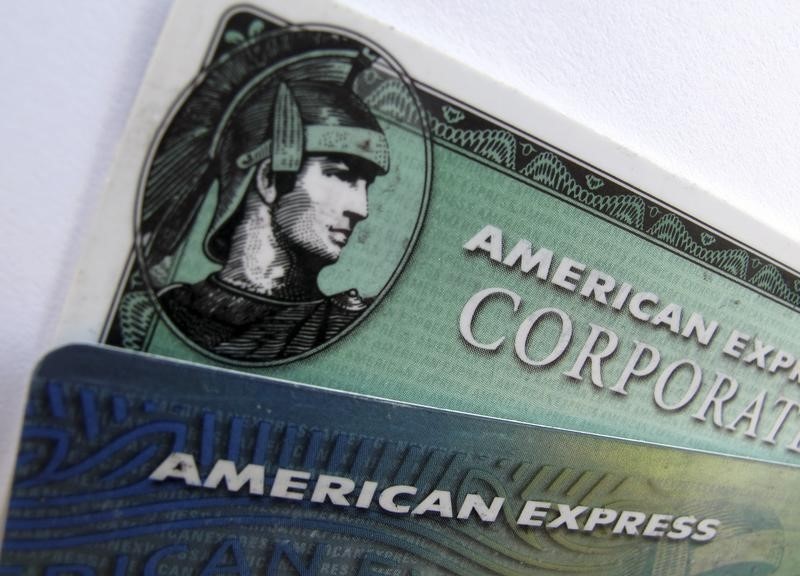
American Express reported stronger-than-expected credit quality, with implied Q4 net charge-offs at about 2.13% versus 2.24% expected and delinquency rates flat year over year through November-December 2025. Offsetting this, fourth-quarter pre-provision net revenue missed due to higher spending on the Platinum card refresh, while adjusted loan growth slowed to 8.6% from 9.7%. FY2026 guidance was broadly in line with expectations, and analysts see EPS rising to $17.60 for the next fiscal year and $20.30 for the following year.
AXP is in the middle of a deliberate mix shift: it is buying a better customer cohort at the expense of near-term margin visibility. The key second-order effect is that premium acquisition can quietly improve the whole P&L stack over 12-24 months: lower loss content, higher fee density, and more durable spend per account, even if headline loan growth looks softer in the next 1-2 quarters. That makes the current debate less about “earnings miss” and more about whether management can turn higher acquisition spend into a higher lifetime value curve faster than rivals can copy the offer.
Competitively, the refresh raises pressure on other premium issuers and travel-partner ecosystems, especially those relying on weaker perks or slower product iteration. If AmEx successfully re-prices value, the industry could see a broader annual-fee ratchet and a redistribution of affluent wallets toward closed-loop platforms with stronger merchant economics. The subtle loser is mass-market rewards issuers: if premium demand is absorbing high-spend customers, their revolver growth and interchange-rich spend growth may be the residual buckets left behind.
The main risk is that this becomes a permanent cost staircase rather than a one-time refresh, with competitor matching forcing repeated benefit inflation over the next 6-12 months. Credit is the counterweight: if macro softens, premium cohorts should hold up better than the market expects, so a deterioration in shares would likely need either a sharp consumer slowdown or evidence that new-account quality is slipping. Consensus may be underestimating how much downside is already buffered by strong credit and dividend durability, but also overestimating how quickly the margin drag reverses.
For trading, the cleanest setup is a medium-horizon long in AXP on any post-earnings/guide skepticism, with a 3-6 month view on operating leverage as acquisition costs normalize. A pair trade long AXP / short a mass-market card issuer or payment-heavy consumer financial where credit quality is more cyclical could express the premium-cohort advantage without taking broad consumer beta. Options-wise, call spreads 6-12 months out are preferable to outright stock if you want to monetize a re-rating while capping exposure to another round of benefit inflation.
AI-powered research, real-time alerts, and portfolio analytics for institutional investors.
Request DemoOverall Sentiment
mildly positive
Sentiment Score
0.20
Ticker Sentiment
