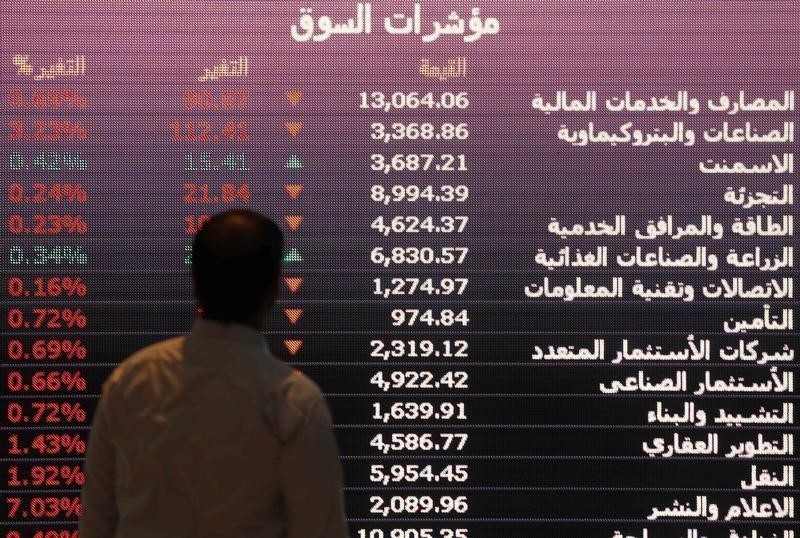
Saudi Arabia's Tadawul All Share fell 0.78% as declines in Petrochemicals, Financial Services and Real Estate Development outweighed gains, with losers outnumbering advancers 211 to 125. Crude oil plunged 11.45% to $83.85 a barrel and Brent dropped 9.07% to $90.38, adding pressure to regional risk sentiment, while gold rose 1.48% to $4,879.60. The Saudi riyal stayed unchanged versus the dollar at 3.75 and EUR/SAR eased 0.16% to 4.41.
This is a classic risk-off tape where the first-order move is lower Saudi beta, but the second-order effect is a tightening in domestic liquidity conditions: falling petrochemicals and power names usually force local de-risking, which can spill into real estate and leveraged consumer listings even if their fundamentals are unchanged. The scale of the oil break matters more than the equity decline; if crude stays under pressure for multiple sessions, Saudi cyclicals with heavy working-capital needs and subsidy-sensitive margins should underperform the index by another 2-4% over the next 1-2 weeks.
The real winners here are not the obvious producers but balance-sheet-resilient, domestically oriented compounders with low commodity linkage and high retail participation. That favors names like APP over hardware/industrial proxies in the U.S. as a relative expression of AI-capex resilience, but in Saudi the analog is defensive services and digitized consumer platforms, which can absorb beta rotation from energy and materials. Conversely, utilities and industrial vendors tied to state capex risk a delayed multiple reset if lower oil persists into budget planning.
The contrarian read is that the oil move may be partially technical rather than purely fundamental, which often produces a violent mean reversion in the most crowded commodity hedge books. If Brent stabilizes within 3-5 trading days, the equity selloff in Saudi is likely to be a short-duration liquidity event rather than a regime change; if not, the market will start pricing slower loan growth and delayed project awards by month-end. For SMCI and APP, the macro impulse is only modestly negative, but higher volatility can actually support dispersion trades in large-cap growth versus broad risk assets.
AI-powered research, real-time alerts, and portfolio analytics for institutional investors.
Overall Sentiment
mildly negative
Sentiment Score
-0.35
Ticker Sentiment
