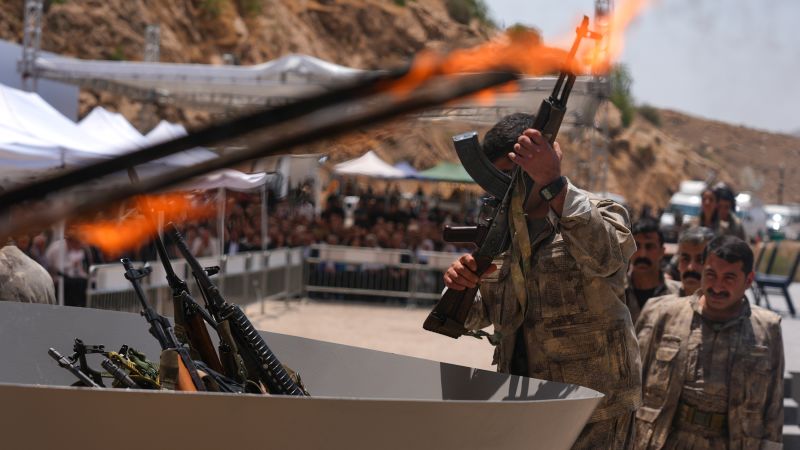
The Kurdistan Workers’ Party (PKK) publicly disarmed a small contingent of militants in northern Iraq, signaling a potential end to their nearly five-decade conflict with Turkey and a strategic shift towards democratic political engagement, following a directive from jailed leader Abdullah Ocalan. This symbolic gesture, welcomed by Turkish and Iraqi officials as a significant step towards regional stability, represents a critical development in a geopolitically sensitive area, though its long-term success remains to be seen given previous failed peace processes.
A symbolic disarmament ceremony by the Kurdistan Workers’ Party (PKK) in northern Iraq represents a significant de-escalation in the nearly five-decade conflict with Turkey. This event, where militants laid down arms and pledged to pursue their goals through “democratic politics,” has been framed by Turkish officials as an “irreversible turning point” and an “important step” towards regional peace. The positive reception from both Turkish and Iraqi authorities, combined with the PKK's prior announcement to cease all activities, signals a potential reduction in geopolitical risk for Turkey. However, the gesture's impact is tempered by historical context, notably the collapse of a similar peace process in 2015 which led to renewed conflict and political crackdowns. While the long-term implications of a lasting peace—including reduced security spending and improved investor sentiment—are substantial, the low market impact score (0.3) indicates that markets are likely discounting the event's immediate significance due to its symbolic nature and the precedent of past failures. The core issue remains the transition from a symbolic act to a durable political settlement, a process that has previously faltered.
AI-powered research, real-time alerts, and portfolio analytics for institutional investors.
Overall Sentiment
strongly positive
Sentiment Score
0.60
