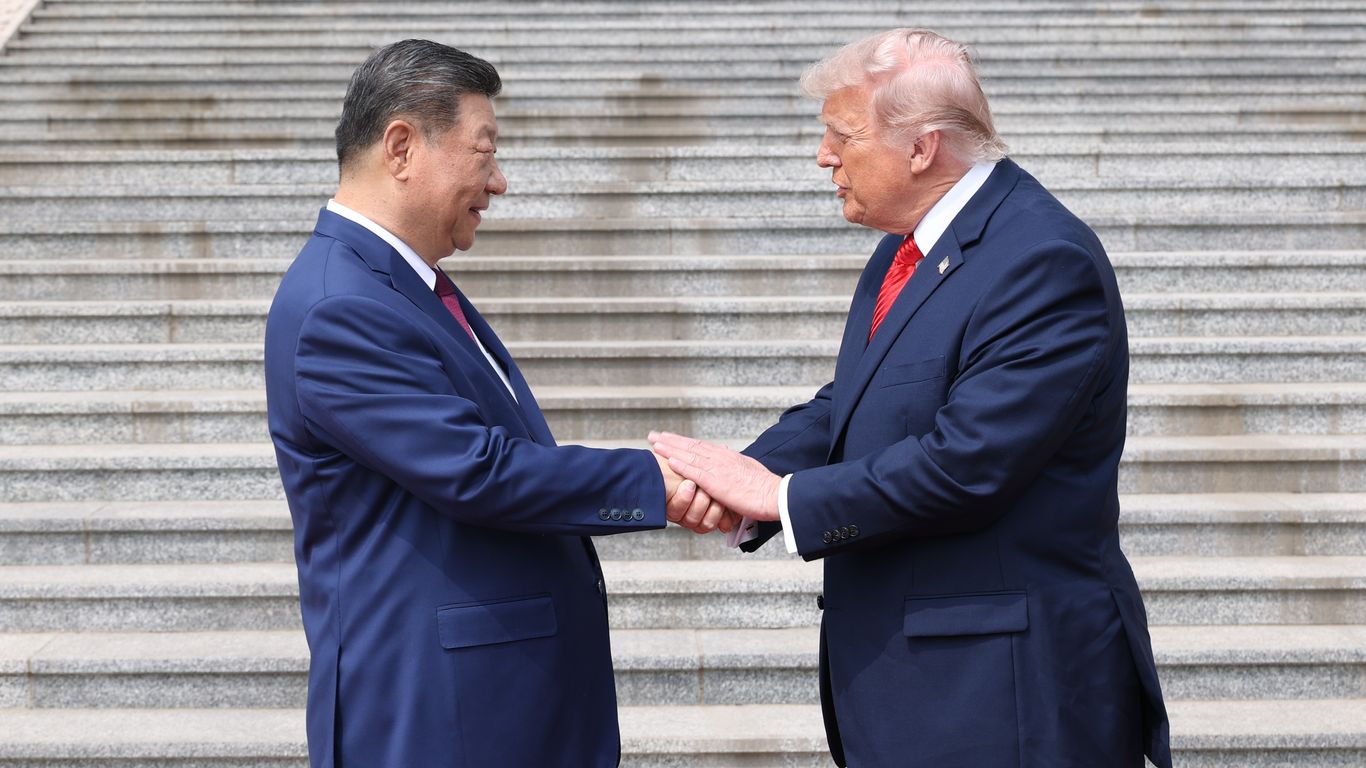
The article highlights a heightened risk that China could move against Taiwan within the next five years, raising concern over potential disruption to the AI chip supply chain. Advisers warned the U.S. is not close to chip supply self-sufficiency, making this a pressing economic and strategic issue for CEOs and the broader economy. The visit also suggests some companies may gain operating licenses in China, but the dominant implication is increased geopolitical and supply-chain risk.
The market is likely underpricing the second-order impact: this is not just a Taiwan headline, it is a convexity event for the entire AI capex stack. The highest-beta exposure is not chips themselves but the bottlenecked ecosystem around them — advanced packaging, HBM memory, lithography, specialty chemicals, and power infrastructure — because even a small probability increase in cross-strait disruption forces customers to overbuild inventory and duplicate capacity outside Taiwan. That creates a near-term spending tailwind for non-Taiwan suppliers while simultaneously putting a structural valuation discount on any name with single-point-of-failure exposure.
The more important investment implication is that national-security procurement will increasingly crowd out pure efficiency-based supply chains. Over the next 12-36 months, U.S. and allied governments are likely to subsidize redundancy rather than optimize cost, which benefits domestic foundry/buildout beneficiaries and equipment vendors, but hurts assemblers and downstream hardware firms with the least pricing power. A Taiwan risk premium also raises the cost of capital for AI infrastructure more broadly, because every hyperscaler will need to model a higher probability of supply interruption into deployment timelines and gross margin assumptions.
The catalyst path is asymmetric: a benign 3-6 month window can lull the market, but the option value of disruption compounds over years. The real tell will be any acceleration in stockpiling, export control tightening, or defense-industrial language around semiconductor resilience; those are the early signals that the market should re-rate the probability of forced onshoring. Conversely, a visible de-escalation package or explicit cross-strait guardrails could compress the risk premium quickly, especially in names whose multiples already embed scarcity scarcity rather than cash flow.
The consensus may be too focused on immediate war odds and not enough on insurance behavior. Even without conflict, a higher perceived invasion probability can fragment the supply chain in a way that is economically equivalent to a tax on AI growth: more inventory, more duplicate fabs, more capex, lower ROIC. That means the trade is less about a binary Taiwan event and more about a multi-year margin-transfer from integrated global hardware models toward geopolitically favored domestic capacity.
AI-powered research, real-time alerts, and portfolio analytics for institutional investors.
Request DemoOverall Sentiment
moderately negative
Sentiment Score
-0.45
