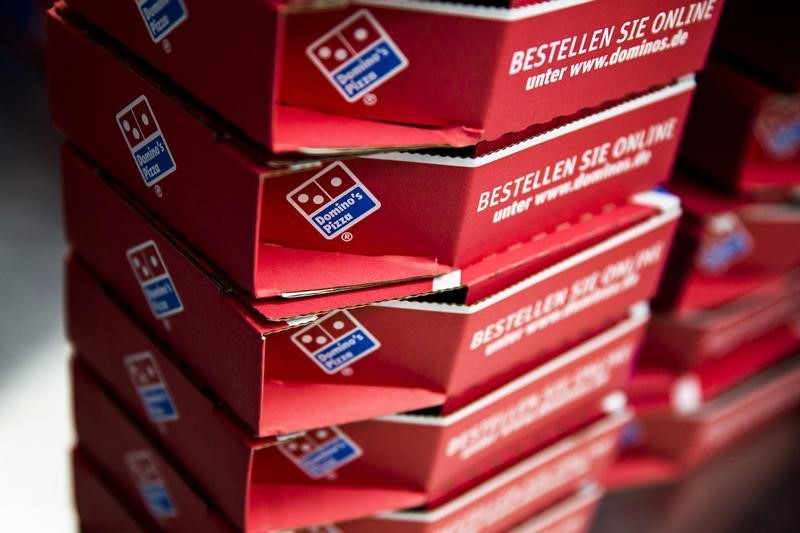
Domino’s VP/Chief Accounting Officer Jessica L. Parrish sold 571 shares at $399.60 ($228,171) and 20 shares at $393.29 ($7,865) on March 11, 2026, leaving her with 3,342.406 direct shares. The stock trades at $401.63 (market cap $13.51B); Domino’s reported Q4 U.S. same-store sales +3.7% (vs Stifel 3.0% and Street 3.2%), with carryout +6.5% and delivery +1.6%. Analysts remain generally constructive—UBS and Stifel reiterated Buys (PTs $500 and $485), Evercore raised its PT to $510 while Bernstein and BMO trimmed targets to $470/$500—InvestingPro notes slight overvaluation despite a Piotroski score of 9.
Domino’s structural advantages (digital ordering, carryout mix, and a franchised, asset-light footprint) create a higher incremental-margin profile than many casual-dining peers; as carryout penetration rises, franchisee labor per order falls, which compounds profitability without commensurate capex. That dynamic not only widens unit-level economics versus regional competitors but also shifts where growth dollars are spent — more on targeted marketing and tech rather than store capex — favoring companies that can scale digital ROI quickly.
Key near-term risks live in input-cost and demand-signal visibility: a surprise jump in cheese/labor inflation or an aggressive promotional response to share loss would compress margins within one to three quarters, while a softer-than-expected summer or promotional misstep would show up in the next same-store-sales print. Positive catalysts are measurable and time-bound — unit openings cadence, international franchising updates, and the summer carryout season — any of which can re-accelerate consensus estimates over a 3–12 month window.
Trade implementation should capture both secular share gain and limited valuation sensitivity: prefer structured upside (call spreads or pair trades) to naked equity exposure given stretched multiples in the category. Second-order opportunities include shorting regional or single-brand peers with higher labor exposure and less digital penetration — those names will see margin compression faster under promotional war or input inflation.
The market is tilting optimistic but under-weights two outcomes: 1) a margin hit from either input inflation or promotional share defense in H2 that re-rates multiples, and 2) continued share gains in underpenetrated suburban/intl markets that would drive steady EPS upgrades. Positioning should therefore be asymmetric — protect against the first while keeping optional exposure to the latter via defined-risk, multi-month structures.
AI-powered research, real-time alerts, and portfolio analytics for institutional investors.
Request DemoOverall Sentiment
mildly positive
Sentiment Score
0.25
Ticker Sentiment
