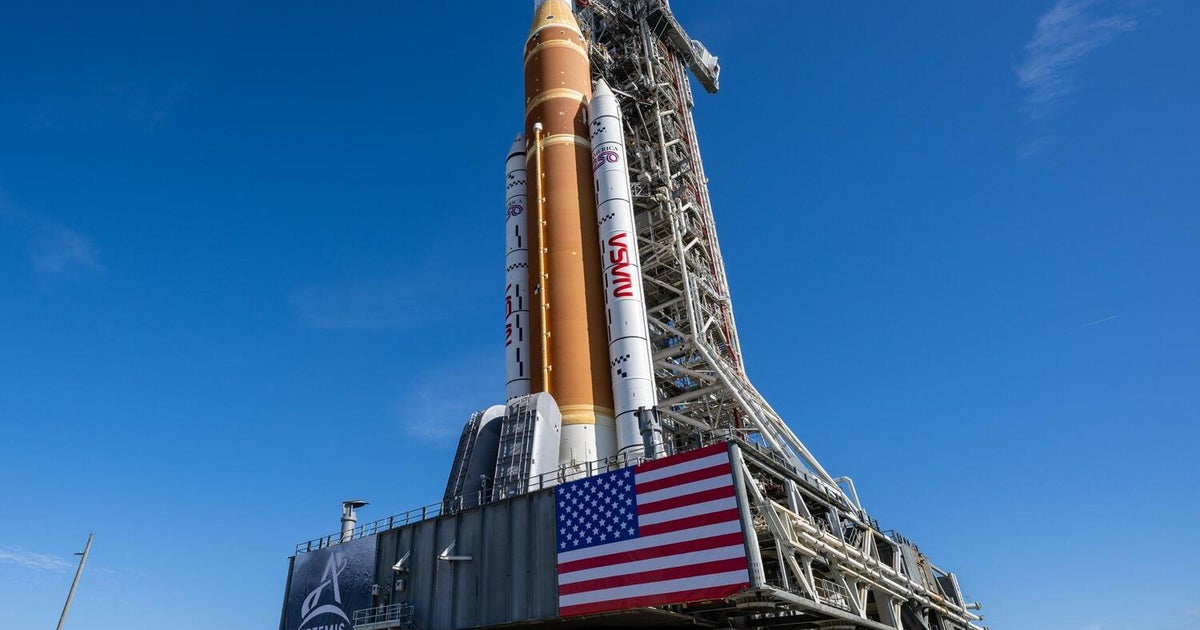
Artemis II's repaired 332-foot SLS rocket is heading back to Launch Pad 39B for a planned April 1 launch attempt (two-hour window opening 6:24 p.m. EDT) to send four astronauts on a nine-day lunar flyby and return. Engineers resolved recent issues — including out-of-place seals in a quick-disconnect helium fitting, replacement/recharge of multiple batteries and seals in propellant umbilicals — and say the next fueling will be for an actual launch with more than 750,000 gallons of liquid hydrogen/oxygen onboard. NASA must launch by April 6 or accept roughly a three-week slip due to orbital and lighting constraints.
The operational issues (cryogenic seals, quick-disconnects, high-pressure helium plumbing and battery reliability) point to supply-chain and integration risk concentrated in specialty components — vendors of cryo-valves, high-pressure fittings and mission-critical battery systems will see contract rework, spare-parts demand and margin pressure in the near term. That creates a near-term revenue uplift for niche suppliers (service-repairs, spares) but raises program-level reliability risk that could compress cadence and increase per-launch unit economics by a material percentage if failures persist.
A slipped launch window has asymmetric effects: schedule compression increases the probability of a rushed remediation (raising failure probability) while a multi-week slip reallocates pad and workforce capacity across the Cape, creating second-order opportunity costs for commercial launch providers who compete for the same infrastructure and personnel. Insurers and prime contractors will price that operational uncertainty into premiums and milestone payments, which can shift cashflow timing for primes and subcontractors over 3–12 month horizons.
Strategically, political optics around hardware reliability amplify downside for heavy-asset primes if a high-profile failure occurs — Congress and agency program managers favor demonstrable success, but repeated issues strengthen the argument for commercial alternatives, potentially redirecting future program dollars over years. Conversely, a clean, on-time piloted flight materially derisks follow-on crewed lunar missions and should unlock near-term contract extensions and option exercises for propulsion, avionics and spacecraft vendors, compressing adoption risk for those suppliers.
AI-powered research, real-time alerts, and portfolio analytics for institutional investors.
Request DemoOverall Sentiment
mildly positive
Sentiment Score
0.25
