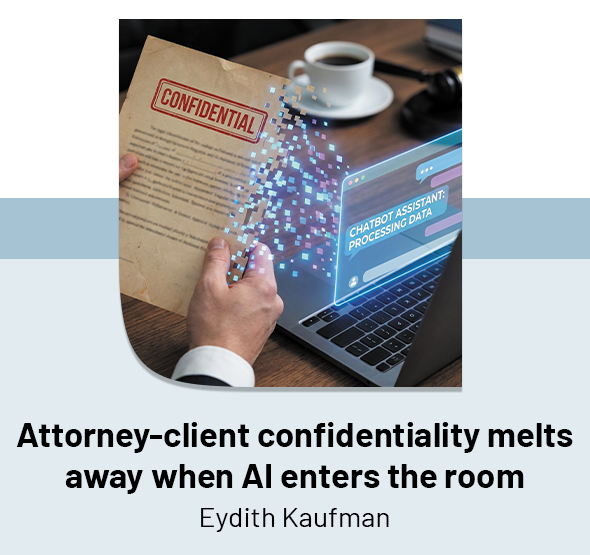
A federal court in U.S. v. Heppner ruled that documents generated with a publicly available AI tool are not protected by attorney-client privilege or work product, warning that consumer-grade AI use can waive confidentiality. The article advises attorneys to use closed-loop, attorney-directed AI tools, especially for mediation materials and client-prepared timelines or case narratives. California bar guidance also emphasizes AI oversight to protect client confidentiality.
The first-order implication is not about legal doctrine; it is about enterprise AI procurement. This ruling increases the cost of using consumer-grade, public LLMs in any workflow that touches privileged or pre-litigation information, which should accelerate demand for closed-loop, auditable, retention-controlled legal AI stacks. The beneficiaries are the vendors that can sell “privilege-safe” deployment, logging, and retention controls to law firms, in-house legal teams, and EDRM-heavy enterprises; the losers are horizontal AI platforms that rely on consumer self-serve usage without strong contractual confidentiality guarantees.
Second-order, this is a governance and liability story for law firms and corporate legal departments. Expect a near-term spike in policy work, training, and vendor review as firms attempt to prove supervision and confidentiality controls, because one adverse privilege ruling can create outsized discovery risk months later in unrelated matters. That should support spend in legal tech, cyber/privacy compliance, and managed services, while increasing scrutiny on AI features embedded in collaboration tools, email, and document management systems that lack explicit data-use restrictions.
The market may be underestimating how much this slows adoption at the margins rather than kills it outright. The practical impact is likely to be a bifurcation: public AI usage will continue for low-risk drafting, but privileged workflows will migrate toward paid, private deployments with enterprise indemnities and contractual non-training terms. The contrarian risk is that the headline sounds restrictive, but in practice it may widen the moat for the biggest incumbents with trusted enterprise relationships, while commoditizing consumer-facing AI use cases in legal services.
AI-powered research, real-time alerts, and portfolio analytics for institutional investors.
Request TrialOverall Sentiment
mildly negative
Sentiment Score
-0.10
