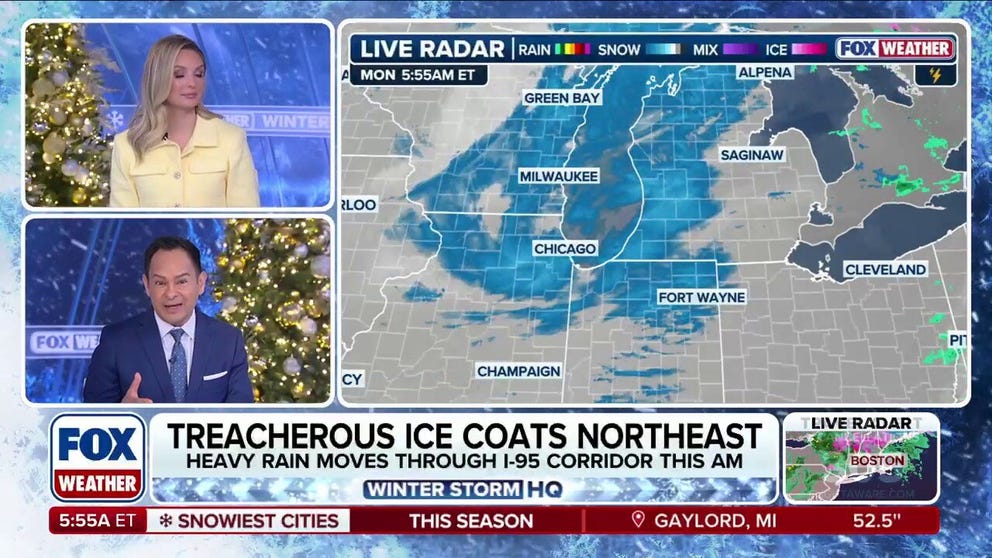
A rapidly intensifying winter storm across the Northern U.S. has produced gusts over 60 mph, caused roughly 300,000 customers to lose power nationwide (about 78,000 in Michigan), and prompted Blizzard Warnings in Minnesota and Wisconsin. Forecasts call for 5–8 inches in parts of the Northern Tier, intense lake-effect snow downwind of Lakes Erie and Ontario potentially exceeding a foot, and localized icing up to a quarter-inch in New England, with models suggesting possible bombogenesis over Lake Michigan — conditions that elevate short-term risks to utilities, regional transportation networks and holiday travel logistics.
Market structure: Immediate winners are short‑term natural gas suppliers and storm‑restoration contractors as heating demand and distribution repair activity spike; expect 5–15% intramonth demand lift for regional gas and a 10–30% revenue bump for contractors on storm work in the following 4–12 weeks. Losers are near‑term travel & logistics (airlines, last‑mile carriers) with holiday cancellations compressing revenue by an estimated 0.5–2% of quarterly revenue per major travel day lost; property/casualty insurers face incremental claims that could pressure short‑term loss ratios by several hundred bps in affected states. Cross‑asset: temporary flight disruption pushes safe‑haven bid into short‑dated Treasuries and raises implied volatility in airline/utility options; nat‑gas futures price sensitivity to regional temperature surprises increases delta and IV for 2–6 week expiries. Risk assessment: Tail risks include a prolonged multi‑day grid outage in densely populated regions (low probability, high impact) that would materially raise utility capex/regulatory intervention and insurer reserve revisions; regulatory action on distribution hardening could force accelerated utility spending cycles over 12–36 months. Time horizon: immediate (0–7 days) travel and airline volatility; short (2–12 weeks) for gas and restoration contractor revenue; medium (3–12 months) for insurers and utility capex repricing. Hidden dependencies: insurance reserve recognition lags losses by a quarter, and restoration contractors’ revenues are lumpy and depend on municipal procurement timelines. Trade implications: Direct plays include short‑dated puts on airlines (AAL, UAL) for 0–3 week volatility, NG call spreads for 2–8 week winter demand exposure, and long positions in storm‑restoration contractors (PWR) and home‑improvement retailers (HD, LOW) for 1–6 month repair demand. Pair trades: long LOW (repair demand) / short AAL (travel disruption) as a relative risk trade; options: purchase 2–6 week NG call spreads and buy 2–3 week put spreads on AAL/UAL to limit downside. Entry: deploy airline puts immediately and scale into NG calls as temperature model convergence within 48 hours confirms colder runs; exit NG if spot moves +20% or weather models normalize. Contrarian angles: The market may underprice restoration capex — municipal and investor pressure after repeated bombogenesis events historically trigger multi‑year utility grid hardening (2012–2014 parallels) that benefits contractors and equipment suppliers (PWR, ETN). Conversely, consensus may overreact on airline damage; once schedules reset within 5–7 days, airline equities often mean‑revert—avoid oversized shorts beyond 1–2% portfolio and prefer option structures. Unintended consequence: accelerated capex could tighten leverage metrics for small regional utilities, creating M&A targets in 6–24 months.
AI-powered research, real-time alerts, and portfolio analytics for institutional investors.
Request DemoOverall Sentiment
moderately negative
Sentiment Score
-0.35
