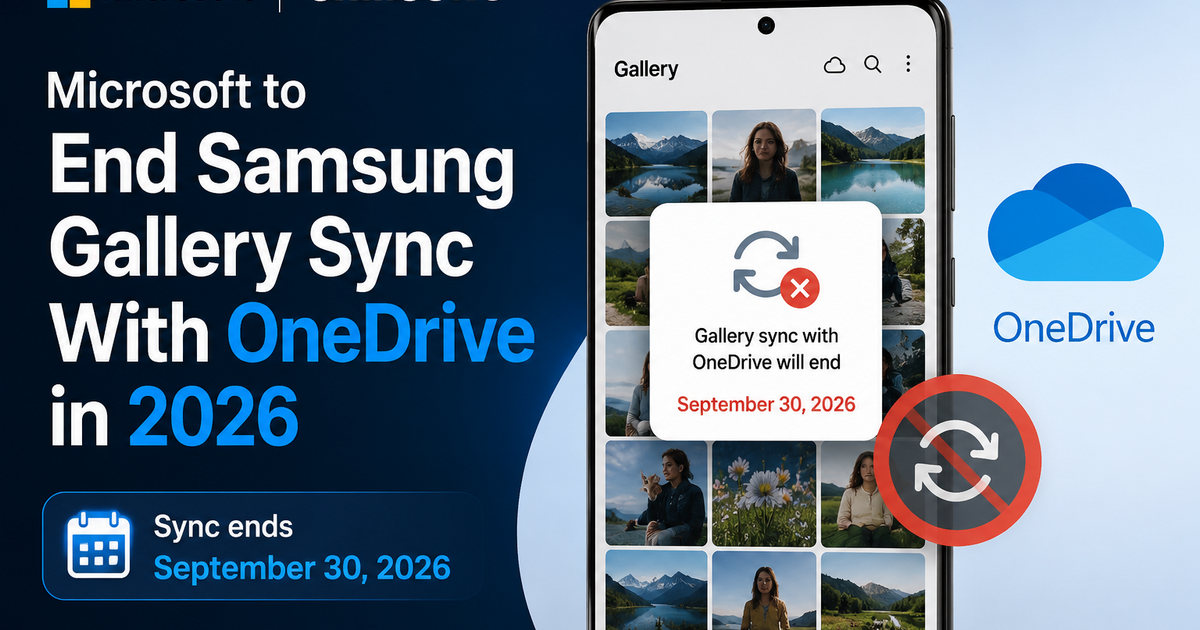
Microsoft will end direct Samsung Gallery syncing with OneDrive on September 30, 2026, after updating its support page on May 14. The change removes automatic photo and video backups for Galaxy users and forces a shift to manual uploads or alternative cloud services. Impact is likely limited to user behavior and ecosystem convenience rather than a material financial effect on Microsoft or Samsung.
This is a small but telling signal that Microsoft is pruning low-differentiation consumer integrations to keep focus on monetizable cloud surfaces. The direct economic hit to MSFT is immaterial, but the behavioral effect matters: once a default backup rail is removed, consumer inertia works against retention rather than for it, and a subset of users will drift to competing ecosystems that bundle photo backup more tightly into the handset experience.
The second-order winner is not necessarily Google alone; it is any platform that reduces user friction at the exact moment of migration. That favors GOOGL/Google Photos, but also OEM-adjacent cloud offerings and device ecosystems where backup is embedded rather than bolted on. For Microsoft, the risk is less lost subscription revenue than incremental weakening of the Windows-Galaxy ecosystem halo, which can quietly reduce cross-sell effectiveness over a 12-24 month horizon.
The market is likely underestimating the cumulative churn effect of many “minor” consumer product sunsets. Individually these changes are noise; in aggregate they create a pattern that consumers interpret as platform instability, making them less willing to standardize on OneDrive for personal media. The contrarian view is that most users will do nothing until the deadline, so the immediate impact is probably overdone, but the migration window creates a clean catalyst starting well before the cutoff as notifications and setup friction hit.
From a trading standpoint, this is more useful as a relative-value signal than a standalone MSFT short. The best expression is a long/short on consumer cloud attachment: long GOOGL vs short MSFT into the migration cycle, or a pairs trade versus CRM-oriented software where consumer ecosystem churn is irrelevant. A less directional option is to buy low-cost GOOGL calls into 2H26 if evidence builds that photo backup migration is flowing to Google Photos rather than third-party storage.
AI-powered research, real-time alerts, and portfolio analytics for institutional investors.
Request DemoOverall Sentiment
neutral
Sentiment Score
-0.10
Ticker Sentiment
