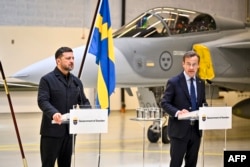
Sweden will donate 16 older-generation Gripen fighter jets to Ukraine, with delivery expected by early 2027, and the inclusion of Meteor missiles could materially extend Ukraine’s air-defense reach beyond 100 kilometers. The transfer is intended to improve Ukraine’s ability to target Russian fighter-bombers, missiles, and drones, but the immediate battlefield impact depends on weapon integration. Kyiv also plans to buy 20 Gripen E/F aircraft later at a cost of about $2.9 billion by 2030.
This is less a near-term airpower shock than a capability-maturation trade with a very specific bottleneck: munitions depth and integration. The real incremental value is not the platform itself, but whether Ukraine gets a standoff air-to-air envelope that forces Russian strike aircraft to launch from farther back, reducing sortie efficiency and increasing fuel, routing, and tanker/air-defense coordination burdens. If that happens, the marginal benefit compounds over months because it degrades the economics of glide-bomb warfare rather than simply intercepting individual attacks.
The second-order winner is the European air-defense and missile supply chain, not necessarily the airframe OEM alone. Any credible move to expand long-range AAM inventory should pull demand through seekers, propulsion, electronic warfare, and depot-level support, while also incentivizing NATO states to accelerate replenishment and backfill their own stocks. The loser set is Russia’s low-cost attrition model: if pilots are pushed outside glide-bomb release zones, Moscow must choose between using more expensive stand-off weapons or accepting lower strike accuracy and higher aircraft loss risk.
Timing matters: the article points to an early-2027 delivery horizon, which makes this a strategic rather than tactical catalyst. Near-term, the market may overprice the headline while underpricing the training, basing, sustainment, and munitions integration constraints that determine whether the jets become meaningful in combat or remain symbolic. The contrarian view is that the move may be underpowered if Meteor supply is limited or politically constrained; without a sustained missile pipeline, the platform’s battlefield effect is modest and the R&D/PR premium should fade.
For investors, the cleanest expression is not in SAAB alone but in a basket of European missile and air-defense beneficiaries, with a preference for names exposed to replenishment cycles and cross-border procurement. A more tactical view is to fade any knee-jerk enthusiasm in pure-play fighter OEMs if the market is assuming earlier operational impact than the integration timeline supports. The asymmetry favors suppliers of missiles, sensors, and maintenance rather than airframes, because wartime burn rates tend to monetize faster than one-off platform deliveries.
AI-powered research, real-time alerts, and portfolio analytics for institutional investors.
Request DemoOverall Sentiment
neutral
Sentiment Score
0.10
