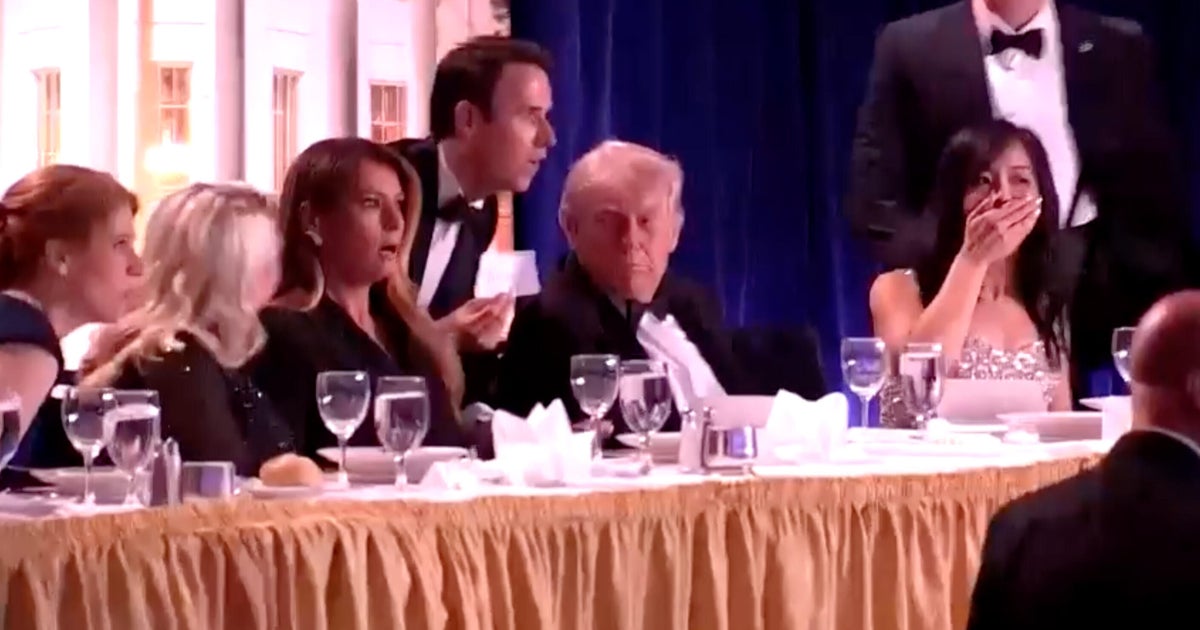
At the White House Correspondents' Dinner, a security scare interrupted President Trump's first attendance at the event in 15 years, prompting an evacuation and a later White House press conference. The article centers on the interaction between the Trump administration and the press, including Trump's remarks about unity and free speech, rather than any direct market or economic development. It is primarily a political and media-focused human-interest piece with minimal market relevance.
The immediate market read-through is not on policy, but on institutional signaling: the optics of a highly visible bipartisan reset reduce near-term tail risk around press regulation, retaliatory rhetoric, and headline-driven volatility in the media complex. That is mildly supportive for large-cap platforms and legacy news franchises that monetize political attention, because a more orderly information environment tends to extend advertising inventory and reduce the odds of abrupt regulatory escalation. The bigger second-order effect is reputational: a president visibly moderating around the press lowers the probability of a sustained confrontation cycle, which has historically been a hidden overhang on media multiples.
The defense and security angle is more subtle. Any event that reminds markets how quickly a domestic incident can force federal security assets into high-alert posture tends to reinforce budget durability for Secret Service-adjacent, surveillance, communications, and event-security vendors over a 6-18 month horizon. The relevant beneficiaries are not the obvious prime contractors alone, but the layer of niche providers with recurring contracts tied to protective detail, secure comms, and venue hardening; those names often see delayed repricing only after procurement budgets respond to a near-miss or failure.
Contrarian takeaway: the consensus will likely underweight how much this compresses immediate political risk premium, but overstate its durability. A single conciliatory event does not change the structural incentive for both sides to re-escalate into the next news cycle, so any optimism in media or governance names should be treated as a tactical trade rather than a regime shift. The fade point is measured in weeks, not years: if the administration pivots back to adversarial messaging or the security episode becomes a broader controversy, the unity premium disappears quickly.
From a trading perspective, the cleanest expression is relative value rather than outright directional exposure. Media names with high political sensitivity may see a short-lived bid, but the better opportunity is to buy weakness in security/defense service providers after any budget revision lag, while fading any multiple expansion in politically exposed broadcasters that depends on a sustained truce. The setup is low conviction but asymmetric because the downside for security budgets is limited, whereas the upside from even one or two contract awards can be material over the next two quarters.
AI-powered research, real-time alerts, and portfolio analytics for institutional investors.
Request DemoOverall Sentiment
neutral
Sentiment Score
0.05
